If you drive a BMW built after 2015, there’s a good chance it runs the B48 engine, and if it’s started leaving small puddles under the front of the car or throwing a coolant warning on a hot afternoon, you’re not alone. A B48 coolant leak is now the single most common cooling fault we see roll into the workshop.
The good news: the B48 fixed the timing-chain problem that plagued its predecessor, the N20. The catch is that BMW still runs a lot of plastic through the cooling system, and Singapore’s heat is hard on plastic. Give it enough hot-cold cycles in this climate and those components start to weep.
Here’s what causes a B48 coolant leak, how to spot one early, and what it actually costs to fix properly.
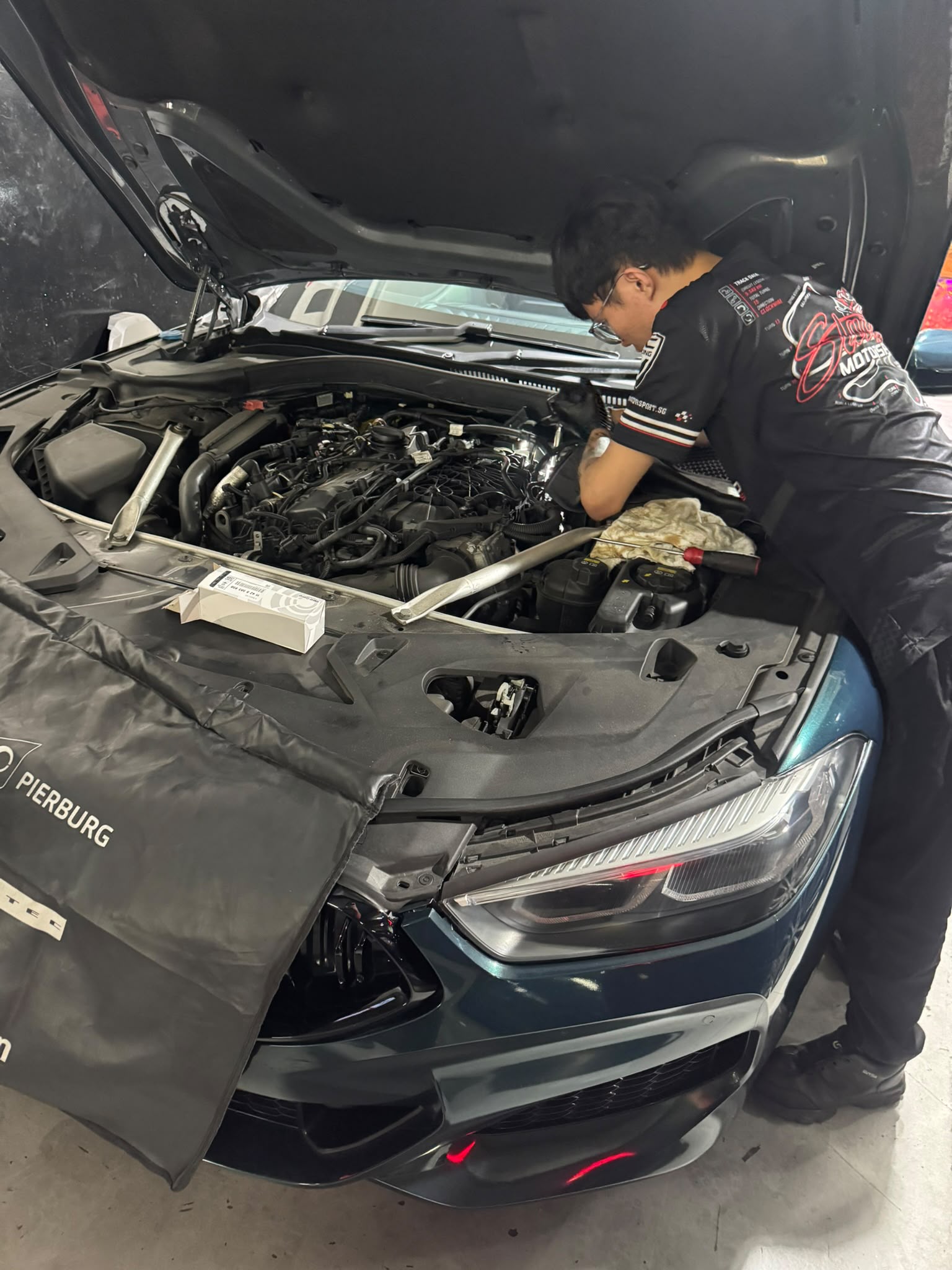
Which BMWs use the B48 engine?
The B48 is BMW’s 2.0-litre turbocharged four-cylinder, and it’s fitted across a huge slice of the current range. If you own any of these, you have a B48:
- 3 Series: 320i, 330i (F30, G20)
- X1 and X3: sDrive20i, xDrive30i
- 2 Series: 220i, 230i
- 5 Series: 520i, 530i
- 1 Series: 118i, M135i (B48 in higher tune)
- Mini Cooper S and JCW (shared engine family)
Because the engine is shared so widely, the same handful of coolant leak points show up again and again regardless of the model badge on the boot.
Why B48 cooling systems leak in Singapore
Two things work against the B48 here. First, the design leans heavily on plastic pipes, plastic housings, and quick-connect couplings. Plastic is light and cheap to produce, but it gets brittle as it ages. Second, our climate never gives the cooling system a break. Constant heat, stop-start traffic, and long idles in car parks mean the system runs hot and cycles through expansion and contraction far more than it would in a cooler country.
Brittle plastic plus constant heat cycling is what eventually opens up a seam or a joint. That’s why most B48 coolant leaks we see are age and heat related rather than a sign the owner did anything wrong.
Common B48 coolant leak points
When a B48 loses coolant, it’s almost always one of these, roughly in the order we tend to find them.
Electric water pump
The B48 uses an electric water pump rather than a belt-driven one. It can fail two ways: it can weep coolant from the housing, or it can die electrically and trigger an overheating warning with no visible leak at all. It’s the first thing we check on a higher-mileage car showing cooling symptoms.
Plastic coolant pipes and quick-connect couplings
These are the sneaky ones. The connectors go brittle and seep slowly at the joint, often only under pressure when the engine is hot. Because they leak in a fine mist rather than a steady drip, owners frequently top up coolant for months without realising where it’s going.
Coolant expansion tank
The plastic expansion tank cracks with age, usually along a moulding seam or around the level sensor. It’s a classic plastic-fatigue failure and one of the more common single-part leaks on the B48.
Coolant transfer pipe and radiator
The transfer pipe running across the engine and the radiator end tanks are both known leak points once the car has some years on it. Radiator seepage in particular is easy to miss because it evaporates fast on a warm engine.
Coolant temperature sensor and heat exchanger
The temperature sensor O-ring can weep, and on some B48s the oil-cooler heat exchanger gasket lets go. That last one matters more than the others, because it can allow coolant and oil to mix, so it’s always worth ruling out when a leak isn’t obvious from above.
Symptoms of a B48 coolant leak
Catching it early saves you from a roadside overheat. Watch for:
- A sweet, syrupy smell after driving, or faint white vapour from the engine bay
- Coolant level dropping and needing regular top-ups
- Small coloured puddles (usually blue or green) under the front of the car
- A low-coolant or overheating warning on the dash
- The temperature needle climbing higher than normal in traffic
If you’re topping up coolant more than once every few months, there is a leak somewhere. Coolant doesn’t get “used up” in a healthy system.
Can you keep driving with a B48 coolant leak?
Short answer: not for long. A slow weep might seem harmless, but the B48 has an aluminium cylinder head, and aluminium warps when it overheats. A cheap coolant pipe left unaddressed can turn into a warped head or blown head gasket, which is a completely different repair bill.
If you get an overheating warning, pull over safely and switch the engine off. Driving on with the temperature in the red is what turns a manageable job into a major one.
How we diagnose a B48 coolant leak
The mistake most people make is guessing from the puddle. The point where coolant drips onto the floor is often nowhere near where it’s actually leaking, because it runs along pipes and panels first.
The right way is a cooling system pressure test. We pressurise the system while it’s cold and watch where it weeps, which pinpoints the exact failed component instead of replacing parts on a hunch. On a BMW we also plug into ISTA, the same diagnostic platform the dealer uses, to read the electric water pump’s live data and check for stored cooling-system faults. That combination tells us whether you’re looking at a single pipe or a system that’s ageing out and due for a wider refresh.
B48 coolant leak repair cost in Singapore
Costs depend entirely on which component has failed and whether you catch it early. As a rough guide for 2026, using genuine or OEM-equivalent parts:
- Expansion tank replacement: S$180 to S$350
- Coolant hose or quick-connector: S$150 to S$400
- Electric water pump: S$550 to S$900
- Radiator replacement: S$500 to S$850
- Full cooling system refresh (pump, thermostat, hoses, tank): S$1,200 to S$2,000
Prices vary with model and parts choice, so treat these as a guide rather than a quote. For how cooling repairs fit into overall running costs, see our breakdown of BMW servicing costs in Singapore. The important point is that a S$200 pipe caught early is far cheaper than the S$4,000-plus you’re looking at if an ignored leak cooks the cylinder head.
Preventing the next leak
Because B48 cooling failures are plastic-fatigue driven, the smart move on an older car is preventive rather than reactive. If one plastic component has failed, the others are the same age and heading the same way. Many owners choose to refresh the water pump, thermostat, and main hoses together once the car passes 100,000 km, rather than replacing parts one at a time as each one leaks. It’s cheaper overall and it removes the risk of being stranded.
A coolant flush at the correct interval also helps, because old coolant loses its corrosion inhibitors and lets the system degrade faster. Our BMW servicing guide for Singapore covers the intervals worth keeping to.
Frequently asked questions
How much does it cost to fix a BMW coolant leak in Singapore?
Anywhere from around S$180 for a cracked expansion tank to S$1,200-plus for a full cooling system refresh, depending on which part has failed. A pressure test first tells you exactly what you’re paying for.
Is the B48 engine reliable?
Yes. It’s a significant improvement over the N20, especially on the timing chain. Its main age-related weakness is the plastic cooling components, which is normal for the platform and manageable if you stay ahead of it.
Can I drive my BMW with a small coolant leak?
Only very briefly, and only to get it looked at. The risk is overheating the aluminium head, which turns a small job into a major one. Don’t drive it if you’re seeing an overheating warning.
How do I know where my B48 is leaking?
You often can’t tell from the puddle alone. A cooling system pressure test is the reliable way to pinpoint the exact leak.
Get your B48 checked before it overheats
A B48 coolant leak is one of the most common and most preventable problems on modern BMWs in Singapore. Caught early, it’s a straightforward repair. Left alone, it’s how good engines end up with warped heads.
At TEC AUTO SERVICES in Woodlands, we diagnose BMW cooling faults with a proper pressure test and full ISTA diagnostics, the same platform the dealer uses, without the dealer pricing. As an independent BMW specialist, we keep the dealer-grade tooling and lose the dealer overheads. If your BMW is losing coolant, running hot, or overdue for a cooling system check, book a diagnostic with us or WhatsApp us at +65 9339 2769.