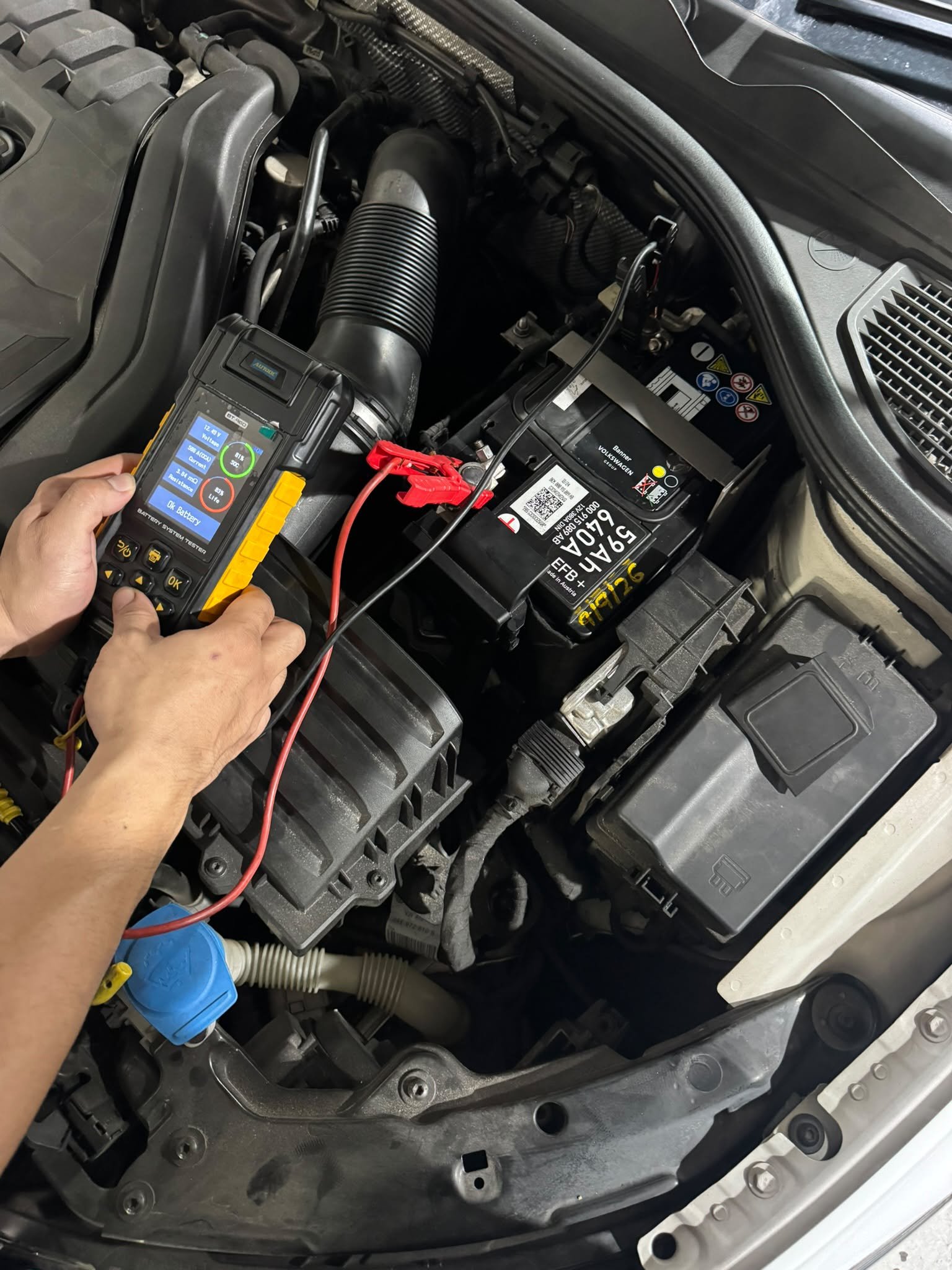
Car battery replacement in Singapore looks like a 15-minute job, but on a German car there’s more to it. BMW, Audi, Volkswagen, Porsche and newer Mercedes-Benz models all manage their batteries electronically, and the car needs to be told when a new one goes in. Skip that step and the car keeps charging your new battery like the old, worn one.
This guide covers the signs of a failing battery, the registration step every German car owner should know about, which battery type your car needs, and what decides the cost.
Signs You Need a Car Battery Replacement
- Auto start-stop stops working. German cars switch start-stop off when battery charge is low, so this is often the first sign.
- Slow cranking, especially in the morning or after the car has sat for a few days.
- Battery warnings on the dashboard, like “Increased battery discharge” on a BMW or “Auxiliary battery malfunction” on a Mercedes.
- Random electrical faults: infotainment rebooting, windows acting up, warning lights that come and go.
- Battery age: anything over 3 to 5 years old is on borrowed time.
Singapore’s heat speeds up battery wear, and lots of short trips make it worse because the battery never fully recharges.
THE STEP MOST PEOPLE DON’T KNOW ABOUT
Car Battery Registration: Why German Cars Need It
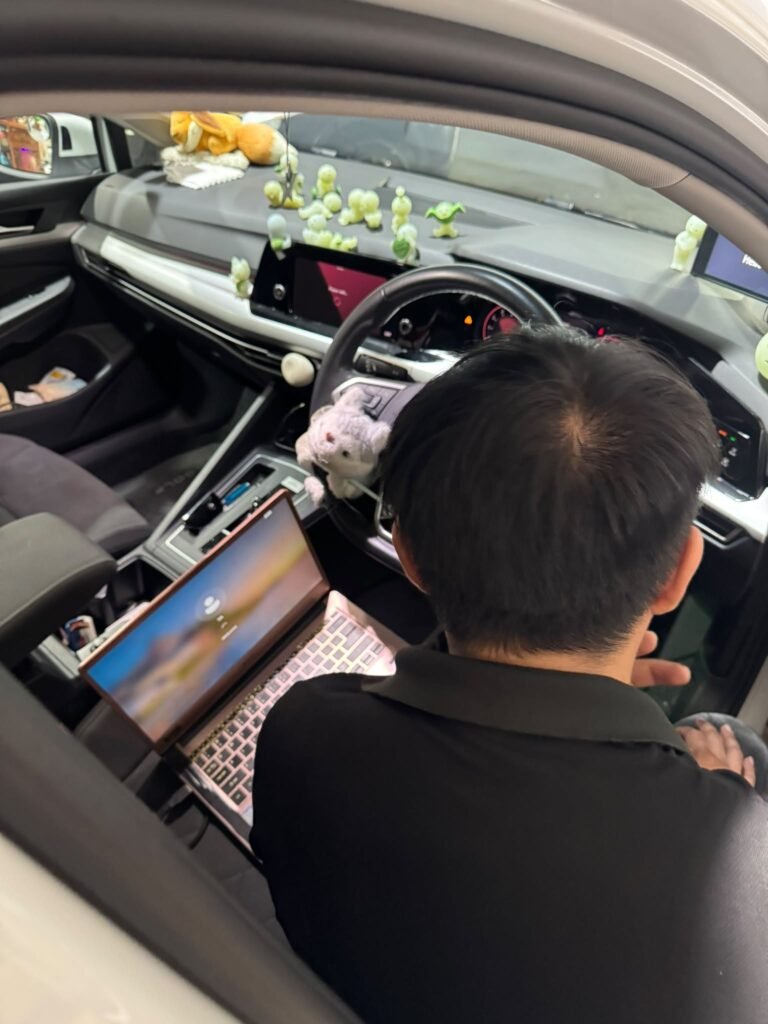
German cars don’t just use the battery, they manage it. A sensor on the battery tracks charge, voltage, current and temperature, and the car adjusts how hard it charges as the battery ages. Registration tells the car you’ve fitted a new battery, so it resets that history and charges the new one correctly from day one.
| Brand | What’s needed after a new battery | Software |
|---|---|---|
| BMW and MINI | Registration on every battery change (all models since 2002). Coding too if the type or capacity changes. | ISTA |
| Audi, VW, Skoda | Battery adaptation on most modern models: the workshop enters the new battery’s part number, serial number and maker into the car. Newer models also store its capacity and type. | ODIS or VCDS |
| Porsche | Registration on modern models, including the 911 (991 onwards), Cayenne, Macan, Panamera and Boxster/Cayman (981 onwards). | PIWIS |
| Mercedes-Benz | Many models don’t need formal registration, but on newer ones the workshop should reset the battery sensor data and re-initialise systems like the windows and sunroof. | XENTRY |
What happens if registration is skipped
- The car keeps using the charging profile of the old battery, so it charges the new one wrongly and it can fail early, sometimes within months.
- Auto start-stop may stop working.
- The car may shut down comfort features to save power, and electrical faults can appear.
Before any battery job, ask one question: “Is registration included?”
Registration vs Coding
Registration is for a like-for-like replacement: same type, same capacity. However, you need coding when the new battery is different, for example a higher capacity or a switch from a standard battery to AGM. The car has to know the new spec to use the right charging profile. Read more in our guides to BMW diagnostics with ISTA and car coding in Singapore.
AGM vs EFB: Which Battery Does Your German Car Need?
| Battery type | Usually found in | What to know |
|---|---|---|
| AGM | Most German cars with start-stop and lots of electronics | Handles frequent restarts and deep discharge. Costs the most. |
| EFB | Some smaller start-stop models | Cheaper than AGM, tougher than a standard battery. |
| Standard (flooded) | Older cars without start-stop | Cheapest. Not suitable for start-stop cars. |
So the rule is simple: replace like for like. Swapping an AGM for a cheaper standard battery usually backfires, because a standard battery in a start-stop car wears out fast.
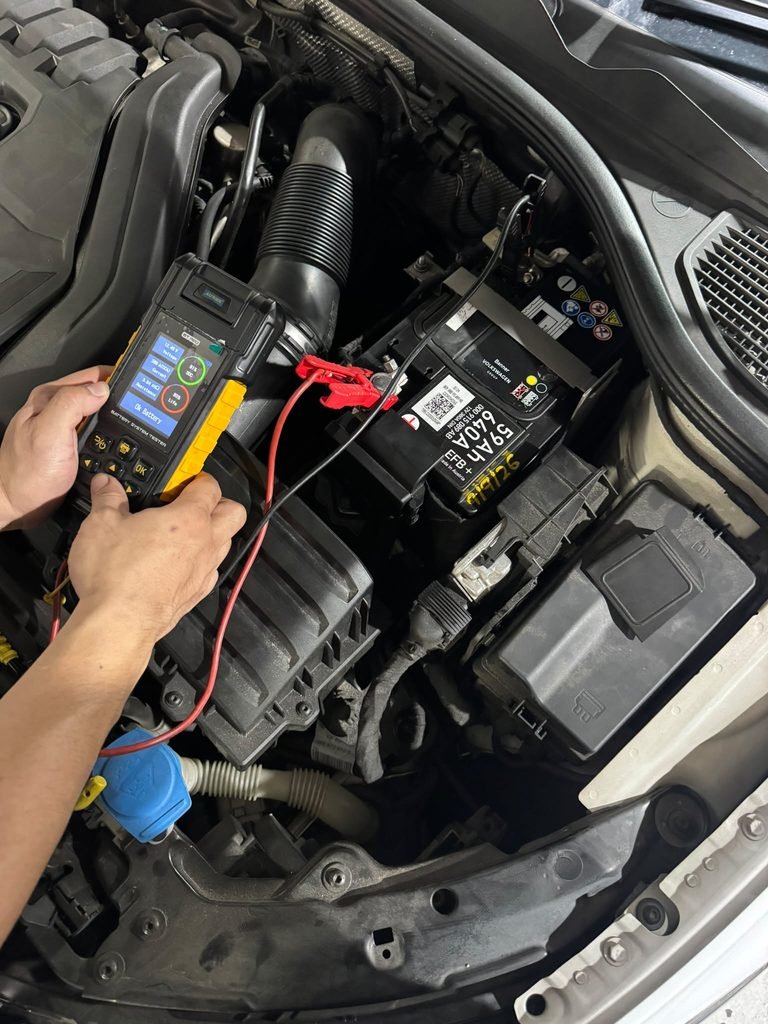
What Decides Car Battery Replacement Cost in Singapore
There’s no single price, because four things change it:
- Battery type. AGM costs more than EFB, and EFB more than standard. However, the factory decides which type your car takes.
- Size and capacity. Each model and engine needs a specific size, measured in amp-hours (Ah). A VW Golf and a BMW X5 need very different batteries.
- Registration and coding. Also, registration is part of every battery change on most German cars. Coding adds a step if the battery spec changes.
- Brand and warranty. OEM-spec batteries cost more than budget brands but usually last longer in Singapore’s heat.
When comparing quotes, check three things: is registration included, which battery brand is it, and how long is the warranty?
Where Is the Battery in a German Car?
On many German cars, it’s not under the bonnet. Many BMW, Mercedes-Benz and Audi models keep the battery in the boot under the floor, and the Porsche 911 has it in the front luggage compartment. The jump-start points are usually under the bonnet, which is why many owners never see the battery itself.
Car Battery Replacement Singapore FAQ
On most modern BMW, Audi, VW and Porsche models, yes. Many newer Mercedes-Benz models also need battery sensor data reset. Older cars without battery management don’t.
Only with the right software: ISTA for BMW, XENTRY for Mercedes-Benz, ODIS or VCDS for Audi and VW, PIWIS for Porsche, or an aftermarket tool set up with the correct battery details.
Usually 3 to 5 years. Heat and lots of short trips shorten that.
It isn’t recommended. Start-stop cars need AGM or EFB batteries, and a standard battery wears out quickly.
Usually under an hour, including registration.
Car Battery Replacement at TEC AUTO
At TEC AUTO, we replace and register batteries on BMW, MINI, Mercedes-Benz, Audi, Volkswagen and Porsche using each brand’s dealer-level software, and code the car to the new battery when the type or capacity changes.
Visit us at 60 Jln Lam Huat #04-61/62, Carros Centre, Woodlands. We’re open Monday to Friday 9am to 6pm, and Saturday 9am to 4pm. WhatsApp +65 9339 2769 with your car model and year for a battery quote.