Last updated 28 November 2026. Written by the TEC AUTO workshop team, Carros Centre, Singapore.
In short
- 48V Audis (A6, A7, A8, Q7, Q8) and the VW Golf 8 eTSI use a 48V battery, a belt starter generator and a DC/DC converter.
- “Electrical system: fault” means that system isn’t charging properly. Audi warns the car can lose power if you keep driving.
- Audi’s bulletins say a new starter generator often won’t fix it. A fault elsewhere on the network can switch it off.
- After a new 48V battery, the car may need online setup with SFD access before the warnings clear.
On a 48V Audi or Volkswagen, “Electrical system: fault” usually means the 48V mild hybrid system has stopped charging properly. The cause can be:
- the 48V battery
- the belt starter generator or its software
- a fault elsewhere on the car’s network that makes the engine computer switch the starter generator off
Audi’s own service bulletins warn that replacing the starter generator often won’t fix it. The right first step is a full scan with ODIS, the Volkswagen Group’s diagnostic system.
Which Audi and VW Models Have a 48V System?
- Audi MHEV (48V): Audi service bulletins list the 48V system on the A6, A7, A8, Q7 and Q8 from around 2018–2019, plus the S and RS versions and the A6 allroad. Some smaller Audis use a 12V mild hybrid system instead, which works differently.
- Volkswagen eTSI (48V): the Golf 8 eTSI pairs a 48V belt starter generator and lithium-ion battery with the 7-speed DQ200 DSG gearbox.
Not sure which system your car has? WhatsApp us your model and year.
The Parts of an Audi and VW 48V System
ODIS treats each part as its own control unit. That’s why a generic scanner can miss the real fault.
| Part | What it does | ODIS address |
|---|---|---|
| 48V battery (battery management 2) | Stores energy; its built-in control unit monitors the cells | 0021 |
| DC/DC converter | Charges the 12V battery from the 48V side | 00C4 |
| Belt starter generator | Restarts the engine, adds a little torque, recovers energy | 00CC |
| Engine electronics and gateway | Decide when the system charges, assists or freewheels | 0001 and 0019 |
4 Common Causes of “Electrical System: Fault”
1. Starter generator software or hardware
Audi’s bulletin for 48V A6, A7, A8, Q7 and Q8 models describes the message “Electrical system: fault. See owner’s manual” with a yellow or red battery symbol. The codes it lists are:
- P0CA700: hybrid battery discharge current too high, stored in the 48V battery
- U046900: a problem with the starter generator’s signal
Audi gives two possible causes: a software issue, fixed with a software update, or a hardware fault in the starter generator. The live data in ODIS tells you which.
2. A different fault that switches the starter generator off
This is the expensive trap.
- A later Audi bulletin covers the same warning with U046900 alongside network and brake servo pressure sensor faults.
- Audi explains that a fault elsewhere on the data network can make the engine computer put the starter generator into freewheel mode. The battery then stops charging, and the electrical system warning appears.
- The bulletin says plainly that replacing the 48V starter generator will not fix it. It also says a starter generator that ODIS can’t reach is not necessarily faulty.
3. The 48V battery
The 48V battery can wear out or develop internal faults, especially in Singapore’s heat and short-trip driving. Its control unit (address 0021) stores its own fault codes, and they need to be read alongside the voltage and charge data before the battery is condemned.
4. A new battery that won’t adapt
Fitting a new 48V battery is only part of the job. On newer VW Group cars, the battery control unit has to recognise the DC/DC converter. The software configuration may also need to be completed online with SFD access, the Volkswagen Group’s protection on newer cars. If either step fails, the warnings stay.
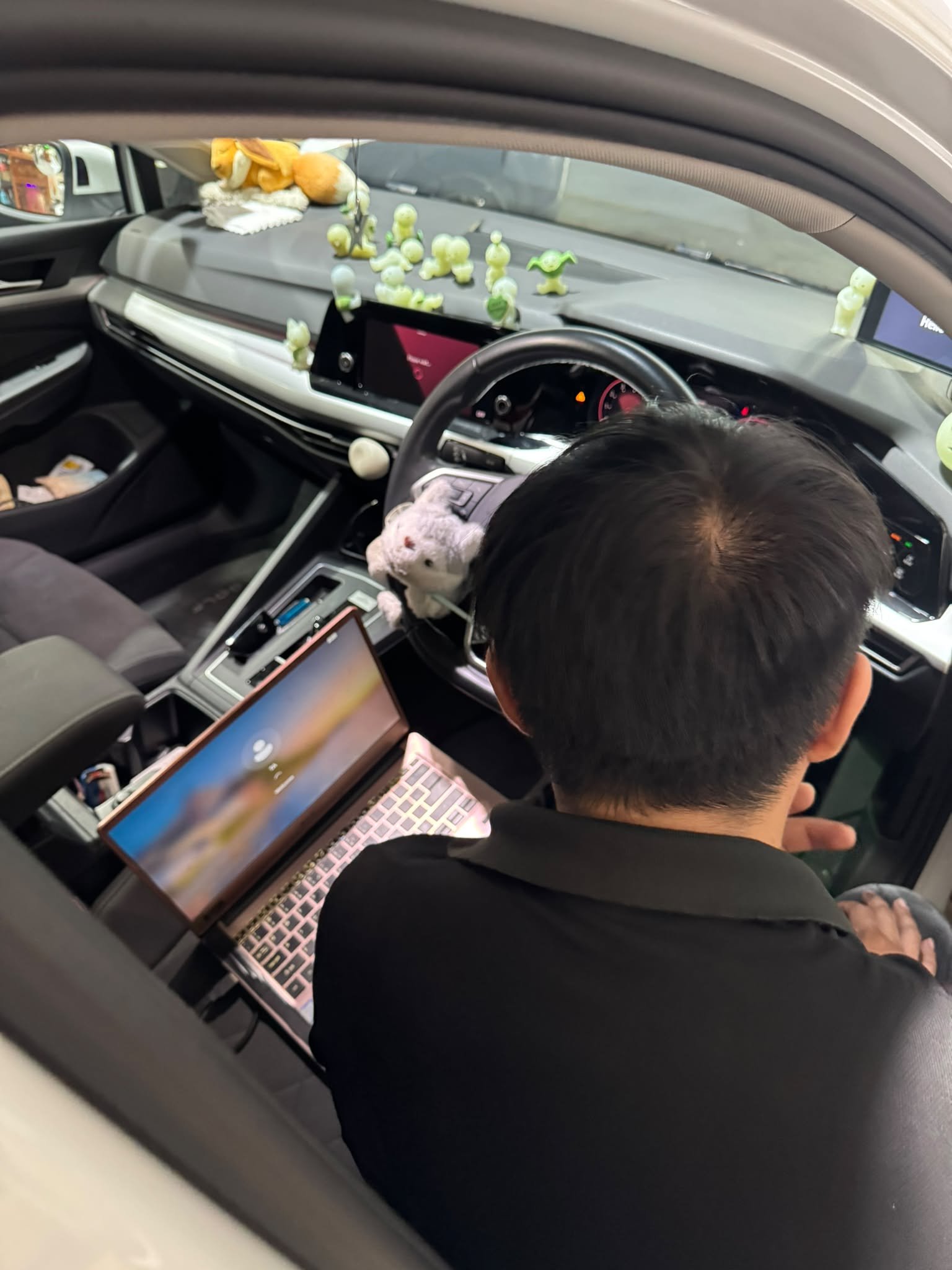
From Our Workshop: Golf 8 1.5 eTSI
A Golf 8 1.5 eTSI came to us after its 48V battery was replaced. The adaptation wouldn’t complete, and the battery control unit stored three faults:
- U029900: no communication with the DC/DC converter
- U031B00: DC/DC converter software incompatible
- P064F00: unauthorised software or calibration
We replaced the battery-related parts and completed the online software configuration (SVM) with SFD access, which resolved it.
The lesson for owners: a new battery with no working adaptation is still a fault. Ask whoever does the job how they’ll complete the configuration on your car. See our guide to SFD and secure coding for why newer cars need online access.
What to Do When the Warning Appears
- Don’t ignore it. Audi warns that if you keep driving, the car could lose power once the battery is excessively discharged.
- Take a photo of the message and note when it appeared: cold start, in traffic, after a long park.
- Don’t start by replacing the 12V battery or the starter generator. Get the fault memory read first.
- If the car is under warranty, or may have an open campaign, check with the dealer first.
How We Diagnose Audi and VW 48V Faults
- A full ODIS scan of every control unit, not just the engine. A network or brake sensor fault can be the real cause. We also use VCDS for quick checks.
- The fault’s extended conditions, such as the starter generator’s recorded mode when the fault happened. Audi’s bulletins use this to tell software, hardware and network causes apart.
- Live data on the 48V battery, the converter and the 12V battery.
- A written quote, then the repair: a software update, the fix for the real fault, or parts replaced and adapted, online if the car needs it.
A diagnostic scan at TEC AUTO costs S$50. If a 48V fault needs more testing time, we tell you the cost before we start, and you get a written quote before any repair.
Audi and VW 48V Repair Cost in Singapore
The cost depends on the cause. A software update or a sensor fault costs far less than a new 48V battery or starter generator.
Every car is quoted individually after diagnosis. WhatsApp us your model, year and the warning message for a first estimate.
For everything we do on mild hybrids, see our 48V mild hybrid servicing page, plus our Audi and Volkswagen workshop pages. If a fault keeps coming back after parts have been replaced, read why VW fault codes return.
Audi and VW 48V Mild Hybrid FAQ
What does “Electrical system: fault” mean on an Audi?
On a 48V Audi, it usually means the mild hybrid system isn’t charging properly. The cause can be the 48V battery, the starter generator or its software, or another fault on the car’s network that makes the engine computer switch the starter generator off. A full ODIS scan shows which.
Will a new starter generator fix it?
Often not. Audi’s own bulletin says replacing the 48V starter generator won’t fix the version of this fault caused by other network or sensor problems. The real fault has to be found first.
Which Audi and VW models have a 48V system?
Audi lists its 48V system on the A6, A7, A8, Q7 and Q8 from around 2018–2019, including S and RS versions. Volkswagen uses it on the Golf 8 eTSI. Some smaller Audis use a 12V mild hybrid instead. WhatsApp us your model and year if you’re not sure.
Why won’t my Golf 8 48V battery adapt after replacement?
The new battery has to communicate with the DC/DC converter, and the car may need online software configuration (SVM) with SFD access. On a Golf 8 1.5 eTSI with faults U029900, U031B00 and P064F00, we replaced battery-related parts and completed the online configuration, which resolved it.
Is it safe to keep driving with this warning?
Not for long. Audi warns that the car could lose power once the battery is excessively discharged. Get it checked as soon as you can.
Can an independent workshop fix Audi and VW 48V faults?
Yes, with ODIS and online access for the cars that need it. TEC AUTO diagnoses and repairs 48V Audi and Volkswagen mild hybrids at Carros Centre, Woodlands.
Sources
- Audi of America TSB 2058831/6, “48V Vehicle electrical system warning, DTC P0CA700 and/or U046900”, March 2023 (via NHTSA)
- Audi of America TSB 2073284/2, “48V MHEV Electrical System Fault with DTC U046900 / 34763”, June 2024 (via NHTSA)
- Volkswagen Newsroom: Golf eTSI, the 48 V mild hybrid in detail
- TEC AUTO workshop records: Golf 8 1.5 eTSI 48V battery adaptation, 2026