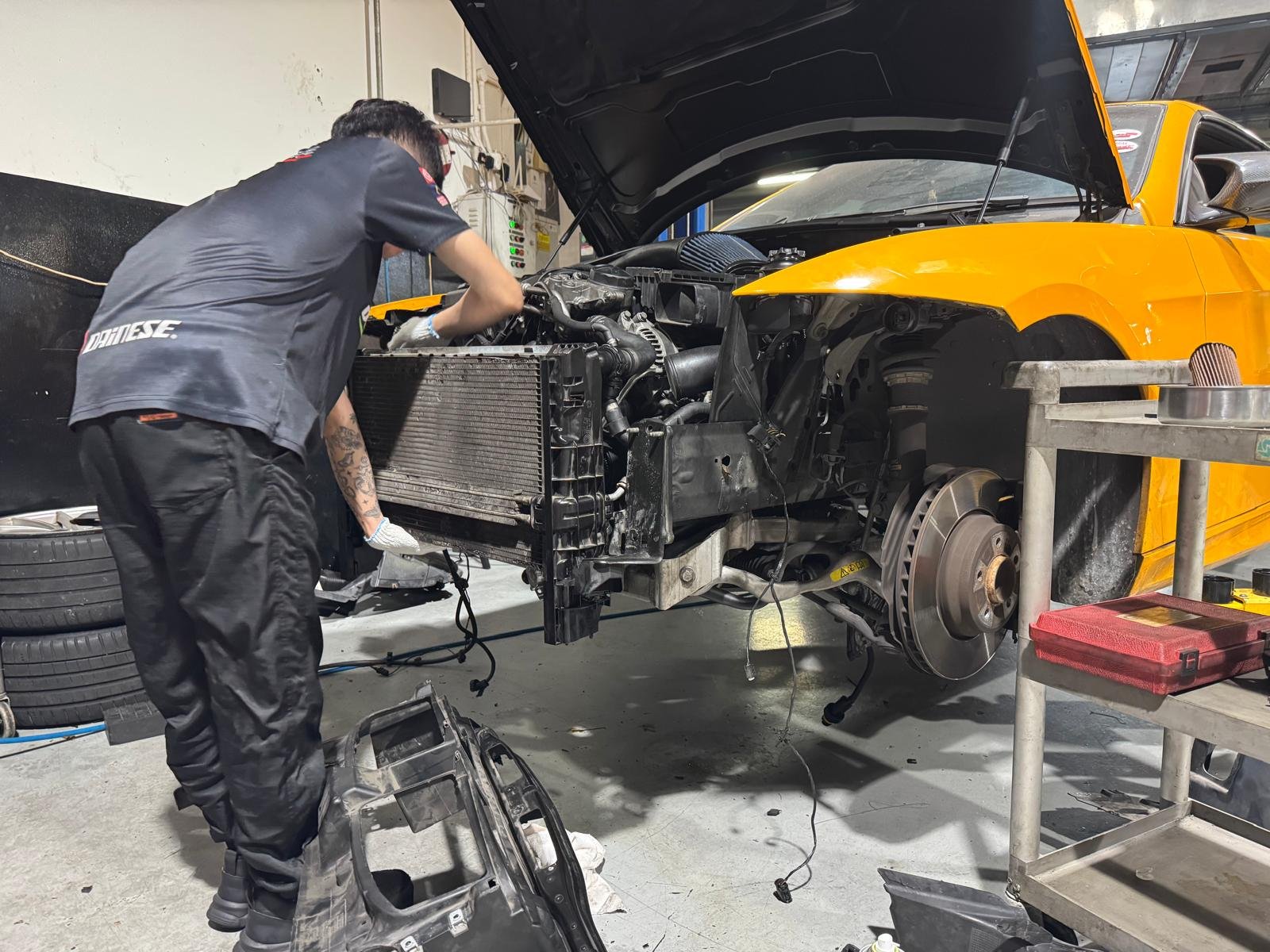
When a BMW arrives on a tow truck in Singapore, the cause is very often the cooling system, not something dramatic like the timing chain or the gearbox. The water pump, the thermostat, the expansion tank and the hoses that hold the whole thing together.
It makes sense once you think about the conditions. Thirty-one degrees, ninety percent humidity, and a car that spends half its life crawling on the PIE with no airflow through the radiator. A cooling system designed for German autobahn cruising is working near its limit every single day here.
The frustrating part is that these failures are almost always cheap to prevent and expensive to ignore. A water pump is a few hundred dollars. An overheated engine with a warped head is a five-figure conversation.
Here is what fails on a BMW cooling system, how to spot it before you are stranded, what the repairs cost in Singapore in 2026, and what to do if the temperature warning comes on while you are driving.
Key takeaways
- Water pump and cooling failures are among the most common causes of BMW breakdowns in Singapore, and among the most preventable.
- Modern BMWs use an electric water pump that fails electronically, often with no leak and no noise, so you get very little warning.
- Most electric pumps fail between 90,000km and 120,000km. Replace the thermostat at the same time, because the labour overlaps almost entirely.
- The plastic expansion tank is a known weak point and cracks with age rather than mileage.
- If the temperature warning comes on, stop driving. Continuing for even a few kilometres can warp the cylinder head.
Why BMW water pumps and cooling systems struggle in Singapore
Three things stack against a BMW cooling system here.
Heat with no airflow. Cooling systems shed heat through the radiator, and radiators need moving air. In stop-start traffic the car depends almost entirely on the electric fan and the water pump. Both run harder, for longer, than they ever would in Europe.
Plastic and heat do not mix. BMW uses plastic extensively in the cooling system: the expansion tank, thermostat housing, hose connectors, and on some engines part of the water pump housing. Plastic under constant heat cycling becomes brittle. In Singapore that ageing runs on a faster clock than the mileage suggests.
Short trips. A lot of Singapore driving is short hops that never let the system reach and hold a stable operating temperature. Constant heat cycling is harder on seals and plastics than sustained running.
The result is that we see cooling failures on cars with modest mileage. A seven-year-old car with 70,000km on the clock is not a low-risk car here. The years matter as much as the kilometres.
The five parts that actually fail
| Part | How it fails | Warning you get |
|---|---|---|
| Electric water pump | Internal circuit board or speed controller dies | Often none, then sudden overheat or limp mode |
| Thermostat | Sticks open or closed | Slow warm-up, poor fuel economy, or overheating |
| Expansion tank | Plastic cracks along the seam, cap seal fails | Coolant smell, slow level drop, puddle |
| Hoses and quick connectors | Plastic connector goes brittle and snaps | Sudden large leak, often with no prior symptom |
| Radiator | End tank cracks or core corrodes | Steady coolant loss, temperature creeping up |
The electric water pump deserves its own warning
Older BMWs used a belt-driven mechanical pump. When one of those failed it usually leaked or squealed first, so you got notice. From the mid-2000s, starting with the N52 engine, BMW switched to an electrically driven pump controlled by the engine computer, and that changed the failure mode completely.
An electric pump usually does not leak and does not make noise. What fails is the electronics inside it. The internal controller degrades, flow rate quietly drops, and the first thing you notice is a coolant warning that appears once and clears, or the car dropping into reduced power mode to protect itself.
That is the part owners misread. A warning light that comes on and then goes away feels like a glitch. On a BMW cooling system it is often the only warning you will get.
When your BMW water pump is due: failure mileage by engine
These are the windows where we start seeing pumps and thermostats come in. Treat them as a prompt to inspect, not a guarantee.
| Engine | Found in | Typical failure window |
|---|---|---|
| N20 / N26 | 320i, 328i, 520i, 528i, X1, X3, Z4 | 80,000 to 100,000km |
| N55 | 335i, 435i, 535i, X3 35i, X5 35i | 90,000 to 120,000km |
| N52 / N53 | 325i, 330i, 523i, 528i, X1 28i | 100,000 to 130,000km |
| B48 | 320i, 330i, 520i, X1, X3, X4 (2016 on) | 90,000 to 120,000km |
| B58 | 340i, 440i, 540i, X3 M40i, Z4 M40i | 100,000km and beyond, plus auxiliary pump faults |
Age matters as much as mileage in Singapore. A twelve-year-old car at 70,000km is still due for inspection.
On B48 and B58 engines there is a second, smaller auxiliary pump that cools the turbo after shutdown. When that one fails the usual symptom is a drivetrain malfunction message and limp mode, which owners often assume is a gearbox or engine fault. It is neither.
BMW water pump and overheating symptoms
- A coolant or temperature warning that appears once and clears. The single most ignored warning on a BMW. Do not wait for it to come back.
- Coolant level dropping with no visible puddle. Small leaks evaporate on hot components before they reach the ground.
- A sweet smell through the aircon vents. That is coolant vaporising somewhere in the engine bay.
- Heater blowing cold, or aircon underperforming at idle. Both can point to low coolant or poor flow.
- Temperature gauge sitting higher than usual in traffic, or the cooling fan running loud and constantly.
- Reduced power or limp mode with no other explanation. The engine computer protecting itself from heat.
- Slow warm-up or worse fuel economy. Classic stuck-open thermostat, and easy to miss because the car still drives fine.
From the workshop: a coolant tank leak caught early
Expansion tank leaks are one of the most common cooling jobs we see. On 22 October a customer brought his car in for exactly that, and wrote about it afterwards:
“I took my car to Tec Auto on 22 Oct to fix a coolant tank leak. The boss and staff were super friendly and gave me clear advice on other repairs needed besides the leak.”
Martin Khoo, Google review
That is why we check the whole system when a car comes in for one leak. A cracked tank is one of the cheaper cooling repairs. Left alone, the same slow leak is how engines end up overheating on the PIE.
How we diagnose it properly
Cooling faults get misdiagnosed more than almost anything else, because several different parts produce identical symptoms. Topping up the coolant and sending the car away is not a diagnosis.
A pressure test. The system is pressurised cold and watched. This finds leaks that only appear under pressure and would never show up as a puddle.
Live data on BMW ISTA. We command the electric water pump directly and watch its actual response and current draw. A pump can fail this test while showing no fault code at all, which is exactly why a generic scanner misses it.
Coolant condition and a pH check. Old, degraded coolant turns acidic and eats the aluminium and gaskets from the inside. A car with brown, cloudy coolant has a bigger problem than whatever brought it in.
Thermal check. Comparing radiator inlet and outlet temperatures shows whether the thermostat is opening at the right point and whether flow is actually happening.
That combination separates a S$150 hose from an S$800 pump job, and it is worth doing before anyone orders parts.
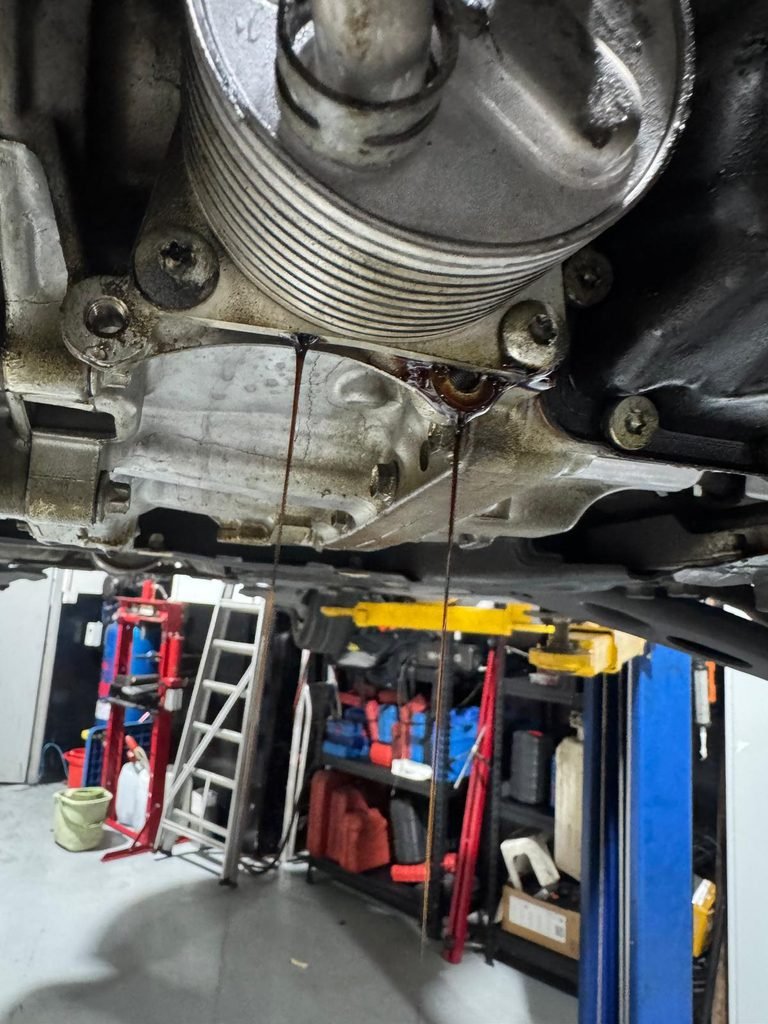
BMW water pump replacement cost in Singapore
Typical 2026 ranges across Singapore workshops. Where your car lands depends on engine, access, and parts choice.
| Job | Typical Singapore range | Notes |
|---|---|---|
| Electric water pump + thermostat | S$400 to S$800 | Do both together, the labour overlaps |
| Thermostat only | S$350 to S$600 | Rarely worth doing alone on a high-mileage car |
| Expansion tank | S$180 to S$350 | Replace the cap at the same time |
| Coolant hose or quick connector | S$150 to S$400 | Cheap part, awkward access on some engines |
| Radiator | S$600 to S$1,100 | Front-end strip-down on most models |
| Coolant flush and refill | S$180 to S$240 | Due every 4 years regardless of mileage |
| Full pressure test and ISTA diagnosis | S$80 to S$150 | Do this before authorising any parts |
At TEC AUTO, an electric water pump with thermostat costs from S$400 on four-cylinder engines like the N20 and B48, up to S$800 on six-cylinder engines like the N55. The other rows reflect typical Singapore prices, not a quote.
Be careful comparing headline prices
Some advertised prices for BMW coolant pump replacement start at a few hundred dollars, which looks unbeatable next to a full quote. Read what is in it. Those headline figures are usually for one specific part on one specific model, and they frequently exclude the thermostat, the coolant, and the system bleed.
The same trap runs the other way with cheap independent quotes. A pump fitted without a thermostat, or without properly bleeding the system, will have you back within the year.
What matters is the scope, not the sticker. When you compare quotes, ask three things: does it include the thermostat, does it include fresh coolant to BMW specification, and does it include a proper vacuum fill and bleed. A cooling system with air trapped in it will overheat even with a brand new pump.
Do it as a package, not one part at a time
This is the single biggest money-saver on BMW cooling work, and most owners find it out the expensive way.
The labour to reach the water pump, the thermostat and the front hoses overlaps almost completely. Draining and refilling the coolant is part of every one of those jobs. Replace the pump alone at 100,000km and there is a good chance you pay most of that labour again eighteen months later when the thermostat goes.
On a car past 90,000km or past eight years old, doing the pump, the thermostat, the expansion tank, the cap and a full coolant change together typically costs a fraction more than the pump alone, and it resets the whole system rather than one part of it.
If you are already renewing COE, this is a job to fold into the renewal budget along with the gearbox service. Ten more years on twelve-year-old plastic cooling parts is not a plan.
If your BMW overheats while driving
This part matters more than anything else on this page.
- Turn the aircon off and the heater on full. It is unpleasant, but the heater matrix is a second radiator and pulls real heat out of the engine.
- Pull over safely and switch the engine off. Do not try to make it to the next exit. Minutes matter.
- Do not open the expansion tank cap. The system is pressurised and the coolant is well above boiling point. People end up in hospital doing this.
- Do not top up with cold water on a hot engine. Thermal shock cracks heads and blocks.
- Call for a tow. A tow costs a hundred dollars or so. A warped cylinder head starts around S$6,000, and a replacement engine is far more.
Owners who keep driving for another ten minutes to get home are the ones who turn an S$800 repair into a five-figure one. This is the one fault where the cheap decision is always to stop.
How to avoid the whole problem
- Change the coolant every four years, whatever the mileage says. BMW’s long intervals were not written for this climate, and degraded coolant corrodes the system from the inside.
- Check the level monthly. Cold engine, look at the tank, takes ten seconds. A slow drop is the earliest warning you get.
- Replace the expansion tank cap with the tank. A weak cap will not hold system pressure and the coolant boils earlier than it should.
- Never ignore a warning that clears itself. On this system, an intermittent warning is an early warning.
- Ask for a cooling system pressure test at every major service once the car passes 80,000km or eight years. It takes minutes and catches leaks while they are still cheap.
Frequently asked questions
What are the symptoms of a failing BMW water pump?
The most common signs are a coolant or temperature warning that appears briefly and clears, coolant level dropping without a visible puddle, the cooling fan running constantly, reduced power or limp mode, and a sweet smell through the vents. Modern BMW electric water pumps often fail electronically with no leak and no noise, so the warning light may be the only symptom.
How much does a BMW water pump replacement cost in Singapore?
An electric water pump with thermostat costs S$400 to S$800 at TEC AUTO in 2026: from S$400 on four-cylinder engines such as the N20 and B48, up to S$800 on six-cylinder engines such as the N55. Always check whether the quote includes the thermostat, fresh BMW-specification coolant, and a proper vacuum fill and bleed, because cheap quotes often leave those out.
How long does a BMW water pump last?
Most BMW electric water pumps fail between 90,000km and 120,000km. In Singapore, age matters as much as mileage because heat cycling degrades the plastic components, so a twelve-year-old car at 70,000km should still be inspected.
Can I keep driving my BMW if the temperature warning comes on?
No. Turn the aircon off, put the heater on full, pull over safely and switch the engine off, then call for a tow. Driving even a few kilometres while overheating can warp the cylinder head, turning a repair of a few hundred dollars into one of several thousand.
Why does my BMW keep losing coolant with no leak?
Small cooling system leaks often evaporate on hot engine components before reaching the ground. Common culprits are a cracked plastic expansion tank, a failing tank cap, a brittle hose quick-connector, or a weeping water pump seal. A pressure test finds these when a visual inspection cannot.
How often should BMW coolant be changed in Singapore?
Every four years regardless of mileage. Singapore’s heat and stop-start traffic degrade coolant faster than the long intervals in the service book assume, and old coolant turns acidic and corrodes the system from the inside.
Should I replace the thermostat at the same time as the water pump?
Yes. The labour to reach both parts overlaps almost entirely, and the coolant has to be drained either way. Replacing the pump alone often means paying most of that labour again when the thermostat fails a year or two later.
What is the auxiliary water pump on a B48 or B58 BMW?
It is a second, smaller electric pump that circulates coolant through the turbocharger after the engine is switched off. When it fails the usual symptom is a drivetrain malfunction message and limp mode, which owners frequently mistake for a gearbox or engine fault.
Summary
Water pump and cooling failures are among the most common reasons a BMW ends up on a tow truck in Singapore, and they are almost entirely preventable. The parts that fail are known, the failure windows are predictable, and the warning signs are consistent. What catches owners out is that a modern electric water pump gives very little notice, so a warning light that appears once and clears is often the only chance you get.
If your BMW is past 90,000km or past eight years old, treat the cooling system as a scheduled job rather than a repair you wait for. Do the pump, thermostat, tank and coolant together while the labour overlaps. And if the temperature warning ever comes on while you are driving, stop the car. That decision alone is worth more than everything else on this page.
Coolant warning on, level dropping, or just want the system checked before it becomes a problem? WhatsApp us at +65 9339 2769 with your model and mileage. We will pressure test the system and run a full ISTA scan before anyone talks about parts.
TEC AUTO SERVICES, 60 Jln Lam Huat #04-61, Carros Centre, Woodlands, Singapore 737869. Mon to Fri 9am to 6pm, Saturday 9am to 4pm. More on our BMW workshop in Singapore.
Related reading
- B48 Coolant Leak in Singapore: Symptoms, Causes and Repair Costs
- BMW Timing Chain Replacement in Singapore: Symptoms, Costs and Which Engines Fail
- BMW Servicing Cost in Singapore: Real 2026 Prices
- Best Independent BMW Workshop in Singapore: How to Choose