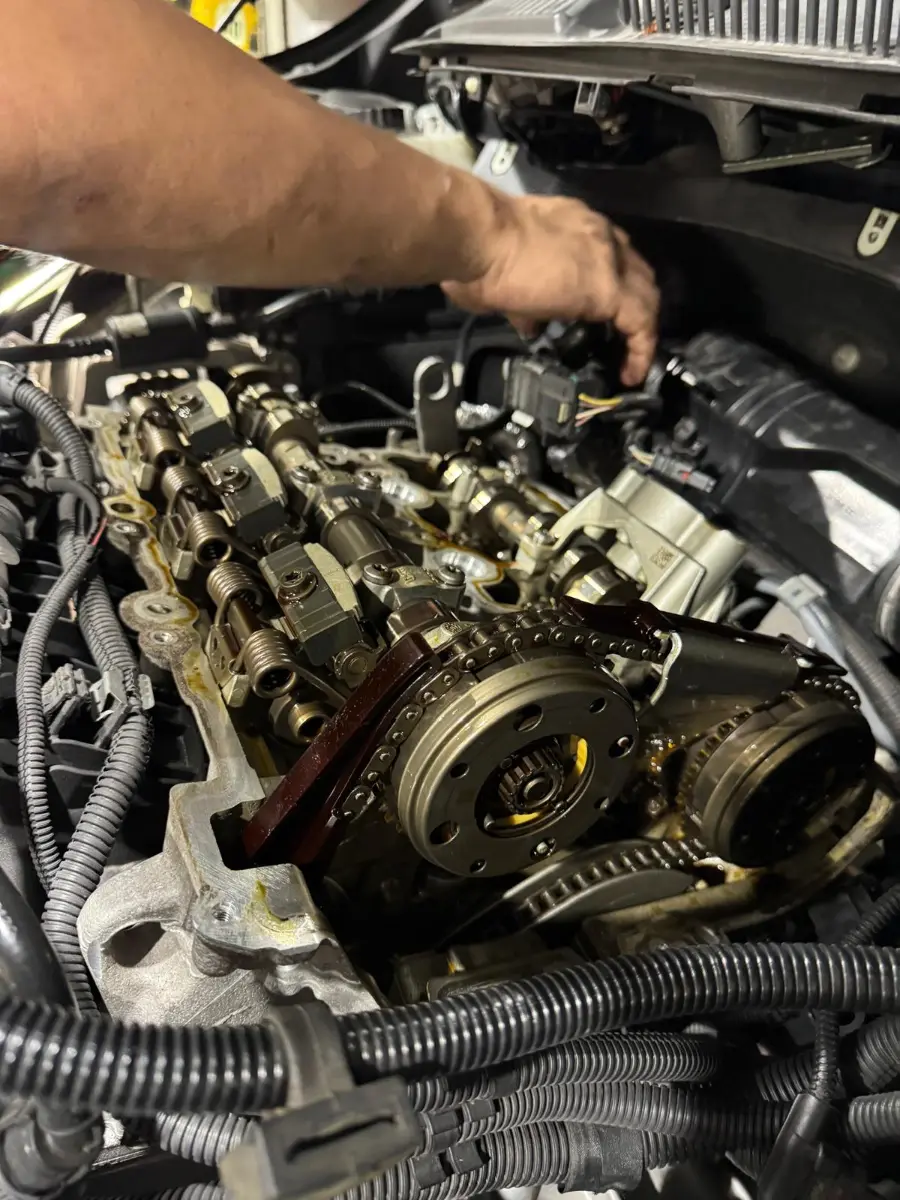
A BMW 320d came into the workshop last month with a sound the owner had been trying to ignore. A light rattle on cold start, gone within a second or two once the engine warmed up, back again the next morning. He’d been told it was “just a diesel thing.” It wasn’t. On ISTA we found camshaft correlation drifting out of spec. When we pulled the cover, the timing chain had stretched and the plastic guides were breaking apart. Another few thousand kilometres and that rattle would have turned a straightforward BMW timing chain replacement into a bent-valve engine rebuild.
With timing chain wear, how early you catch it decides whether the fix is cheap or catastrophic. Here’s what the timing chain does, which BMW engines are known for chain trouble, how to spot it early, and what BMW timing chain replacement costs in Singapore in 2026.
What a BMW timing chain actually does
The timing chain links the crankshaft at the bottom of the engine to the camshafts at the top. That keeps the valves opening and closing in time with the pistons. A timing belt is rubber and gets swapped on a schedule. A chain is metal, and BMW designed it to last the life of the engine. That’s the theory.
In practice the chain runs on plastic guide rails, and a hydraulic tensioner keeps it tight. Over years and tens of thousands of kilometres the chain slowly stretches and the guides wear and crack. The tensioner then runs out of travel trying to keep everything tight. Once there’s slack, the timing starts to slip. On an interference engine, which is what every modern BMW is, valves and pistons share the same space at different moments. If the timing slips far enough, they meet. That’s the engine-destroying scenario, and it’s why a chain rattle is never something to sit on.
Why BMW timing chains fail
None of this means BMW built these engines badly, but a few BMW engines earned a reputation for chains that wear faster than they should. Across all of them, the causes are the same.
The plastic guide rails go brittle with age and heat, then crack and shed pieces into the oil pan. The tensioner and chain stretch past the point where the tensioner can compensate. And oil is the hidden factor. The chain and tensioner depend on clean oil at the right pressure, so long oil-change intervals and low oil level wear a chain out faster. A car that only ever does short trips and infrequent servicing is the worst case.
Why Singapore driving is hard on timing chains
Cars here don’t clock big mileage, so a lot of owners assume the chain has an easy life. The way we drive says otherwise. Most trips are short: the run to the office, the school drop-off, a weekend hop to the mall. The engine spends a big share of its life warming up or crawling in stop-start traffic on the PIE and CTE. Short trips don’t give the oil enough time at full temperature to burn off moisture and fuel. Add the heat, and oil wears out faster than the service light assumes.
The tensioner runs on oil pressure, so tired oil means a tensioner that can’t keep the chain tight. That’s why we see chain wear on cars that look low-mileage for their age. A ten-year-old 320i with a modest odometer reading isn’t low-risk just because the number is small.
BMW engines known for timing chain problems
If you drive one of these, the timing chain is worth knowing about. Not every car will fail, but these are the engines we see chain jobs on. Not sure which engine your car has? Our workshop guide to common BMW engine problems by engine code shows you how to check.
N47 2.0 diesel
The 116d, 118d, 120d, 316d, 318d, 320d, 520d and the diesel X1 and X3 from roughly 2007 to 2014. This is the best-documented one. The chain sits at the back of the engine, against the gearbox, so reaching it means dropping the subframe and separating the engine and transmission. The fault is common and the repair is labour-heavy, which is the worst combination.
N20 2.0 petrol turbo
The 320i, 328i, 420i, 428i, 520i and 528i, plus the X1, X3, X4 and Z4 with 20i or 28i badges, mainly 2012 to 2015 builds. Early-production engines are the vulnerable ones; BMW updated the chain parts on later cars. Like the diesels, the N20 has its chain at the back of the engine, against the bulkhead, so it is a labour-heavy job. To reach it we drop or shift the subframe and, on some chassis, partly lower the engine. Symptoms usually show as a cold-start rattle and camshaft correlation faults. (You’ll see the N26 mentioned online too. It’s the US-market version of the same engine and rare on Singapore roads.)
N13 1.6 petrol
The earlier 116i and 118i. Same family of guide and tensioner wear.
N57 3.0 diesel
The 330d, 530d, 730d and the X5 and X6 30d. Like the N47, the chain sits at the gearbox end. Failures are less common than on the N47, but when one does need doing, it’s the most labour-heavy chain job on this list.
Newer B48, B58 and B47 engines
BMW’s current B48 and B58 engines (the petrol fours and sixes in most 2016-onward 320i, 330i, 340i, X3 and similar) got a redesigned chain setup and hold up far better. They’re not a common chain-failure engine. If you’re in a recent BMW, this is a maintenance awareness item, not something to lose sleep over. The same goes for the B47 diesel that replaced the N47 from around 2015. Its chain is still at the back of the engine, but it hasn’t shown the N47’s pattern of failures.
Symptoms of a worn BMW timing chain
Chain wear comes on gradually, and the early signs are easy to explain away. Watch for:
- A rattle on cold start, loudest in the first second or two before oil pressure builds, especially on the N47 diesel
- A metallic rattle or whine at idle from the timing chain end of the engine
- The check engine light with camshaft or crankshaft correlation codes
- Rough running, misfires or a noticeable loss of power
- Fine plastic or metal debris in the oil filter or sump when the car is serviced
The tell is the cold-start rattle that fades as the engine warms. A lot of owners get used to it over months. If your BMW has started making a noise on startup that it never used to, that’s the point to get it checked, not after it gets louder.
Why you can’t wait on a chain rattle
A worn chain doesn’t fix itself and it doesn’t fail politely. It stretches a little more each week, and the failure mode is the chain jumping a tooth or the guide collapsing while the engine is running. On an interference engine that means valves hitting pistons, and the repair jumps from a chain job to a cylinder head or a full engine. We’ve seen both outcomes on the same model, and the only difference was how early the owner acted on the noise. A chain caught while it’s still just rattling is a manageable repair. A chain left until it snaps is often a written-off engine.
How we diagnose timing chain wear
We don’t open an engine on a hunch. On a BMW we plug into ISTA, the same diagnostic platform the dealer uses, and read the live camshaft-to-crankshaft correlation values along with any stored timing faults. That tells us whether the timing has actually drifted or whether the noise is coming from somewhere else, like the belt tensioner or an accessory pulley. We’ll also listen with the engine cold, and check the oil and filter for plastic debris, which is often the giveaway. We only quote a BMW timing chain replacement once we have confirmed the chain is the problem. Our approach to BMW diagnostics is the same across every car, and you can read more in our piece on why we use ISTA on every BMW.
What a BMW timing chain replacement involves
A proper timing chain job is not just the chain. We replace the chain, the guide rails, the tensioner and the sprockets as a set, plus gaskets and seals, because reusing worn guides with a new chain is asking to do the whole job again. On both the N20 petrol and the N47 diesel, the chain sits at the gearbox end of the engine, and that is where the labour goes. On the N20 we drop or shift the subframe and, depending on the chassis, partly lower the engine to reach it. For the N47, the engine and gearbox usually have to come apart, which adds more hours again. We use quality OEM-grade chain components, because a cheap chain kit on an engine like this is a false economy.
BMW timing chain replacement cost in Singapore
Cost depends almost entirely on which engine you have and how hard the chain is to reach. The parts cost much the same from engine to engine. The labour is what changes. As a rough guide for 2026:
| Engine | Typical timing chain replacement (2026) |
|---|---|
| N20 petrol (rear chain, subframe lowered) | S$1,200 to S$1,800 |
| N13 1.6 petrol | S$1,500 to S$2,600 |
| N47 2.0 diesel (engine/gearbox out) | S$3,500 to S$6,000 |
| N57 3.0 diesel | S$4,000 to S$7,000 |
These are indicative ranges, not a quote. The final figure depends on the exact model, what else is worn once we’re inside, and whether related parts like the water pump or oil pump chain are done at the same time while access is open. For how a job like this fits into the bigger picture of running a BMW here, see our breakdown of BMW servicing costs in Singapore.
Fix the chain or let the COE run out?
Many of the N20 and N47 cars still on the road are ten years old or more, which puts their owners right at the COE renewal decision. A BMW timing chain replacement is real money to spend on a car you might deregister in a year or two.
Our view: if you’re renewing the COE and keeping the car for another five or ten years, do the chain properly now. A failed chain on a car you’ve just paid to renew is the worst outcome of all. If the car is heading for deregistration soon and the chain has only just started to rattle, talk to us about the risk before you spend. We’d rather give you a straight answer than sell you a repair you won’t get value from.
Can you make a timing chain last longer?
You can’t stop a chain wearing, but you can slow it down, and it comes down to oil. Keep to sensible oil-change intervals with a good-quality oil rather than stretching to the maximum the service light allows. Check your oil level between services so the tensioner is never running on a low level. Clean oil at the right level is what keeps the chain and guides alive. It won’t make a bad N47 chain immortal, but it’s the difference between a chain that lasts and one that wears out early. Our BMW servicing guide for Singapore covers the intervals worth keeping to.
Frequently asked questions
How much does BMW timing chain replacement cost in Singapore?
As a guide, roughly S$1,200 to S$1,800 for an N20 petrol, where the chain is reached by lowering the subframe, and S$3,500 to S$6,000 or more for an N47 diesel because the engine and gearbox have to be separated to reach it. A diagnostic first confirms the chain is actually the problem.
Which BMW engines have timing chain problems?
The N47 2.0 diesel (2007 to 2014) is the best known, along with the early N20 2.0 petrol turbo (around 2012 to 2015), the N13 1.6 petrol and, less often, the N57 3.0 diesel. BMW reworked the chain setup on its newer B48 and B58 engines, and they rarely have chain issues.
What does a bad BMW timing chain sound like?
Usually a rattle on cold start that fades once the engine warms up, sometimes with a metallic whine at idle. On the N47 diesel it’s often described as a “death rattle” from the back of the engine. If a startup noise is new, get it checked before it gets louder.
Can I still drive with a rattling timing chain?
You shouldn’t. A worn chain can jump or the guides can collapse without much warning, and on a BMW that means valves hitting pistons and a possible engine rebuild. Driving on a known chain rattle is the single most expensive gamble you can take with these engines.
Do BMW B48 and B58 engines have timing chain problems?
Not commonly. BMW reworked the chain and guide design on the B-series, so the current 320i, 330i, 340i and similar are far more reliable on this front than the older N20 and N47. Keeping to good oil intervals is still worth doing.
How long does a BMW timing chain last?
There’s no set replacement interval. BMW designs the chain to last the life of the engine, and on the B48 and B58 most do. On the problem engines (N47, early N20) wear tends to show at higher mileage, but stretched oil changes and lots of short trips bring it on much earlier. Mileage alone won’t tell you. A cold-start rattle or a camshaft correlation fault will.
Is it worth replacing the timing chain on an older BMW in Singapore?
It depends on your COE plans. If you’re renewing and keeping the car for years, yes: a chain job costs far less than the engine it protects. If the car is due for deregistration soon, get it diagnosed first so you know how far gone the chain is, then decide.
Get the rattle checked before it gets expensive
A timing chain is one of those repairs where acting early saves an engine and waiting costs one. If your BMW has picked up a rattle on cold start, is throwing a timing or camshaft correlation code, or it’s an N47 or early N20 with the miles to match, it’s worth having the chain checked properly rather than hoping the noise goes away.
At TEC AUTO SERVICES in Woodlands, we confirm timing chain wear with full ISTA diagnostics before we open anything, then replace the chain, guides, tensioner and sprockets as a set with quality parts. As an independent BMW specialist, we keep the dealer-grade tooling and lose the dealer overheads. If your BMW is rattling on startup or overdue for a check, book a diagnostic with us or WhatsApp us at +65 9339 2769.