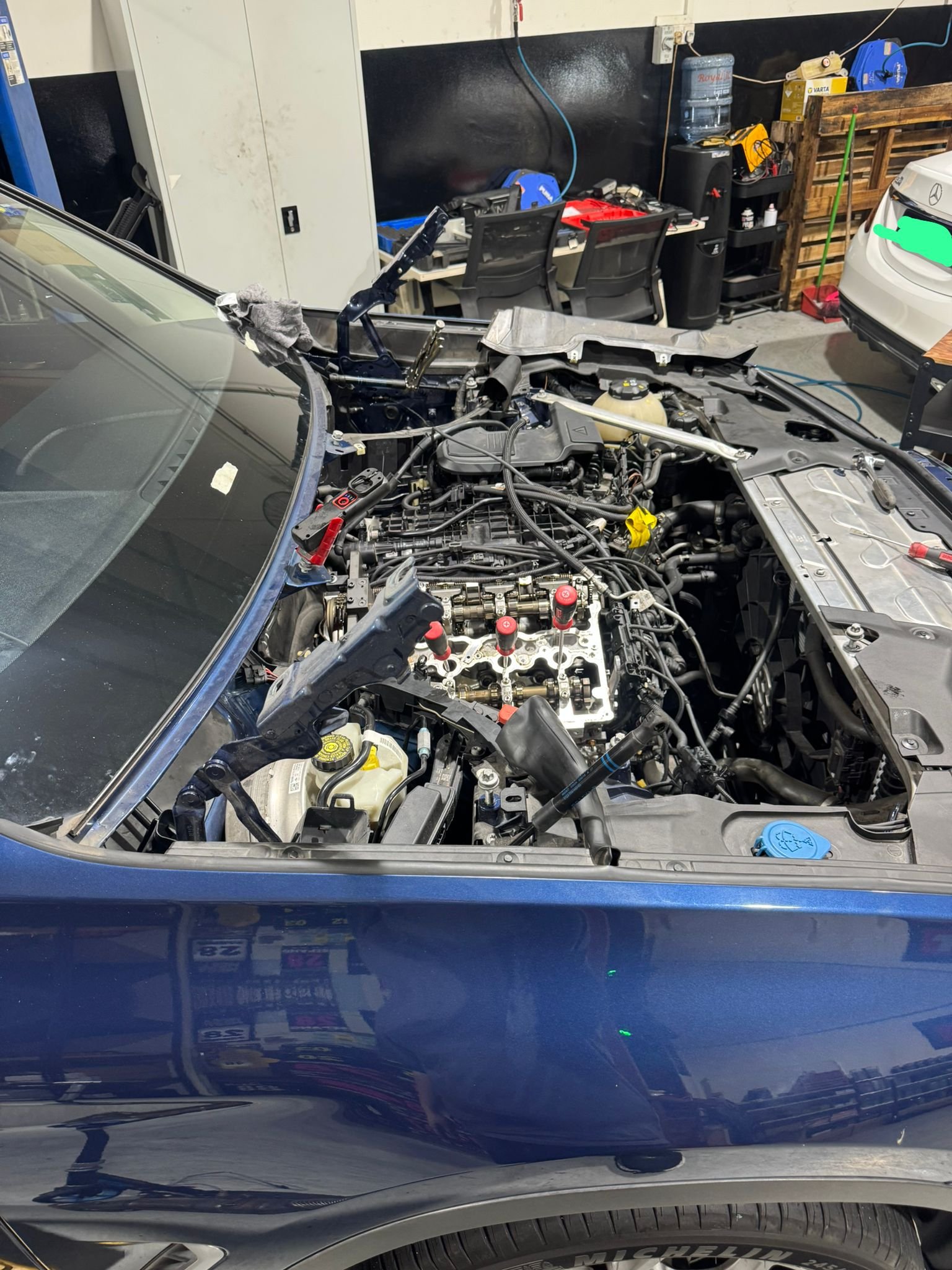
A 330i came into our workshop at Carros Centre last month with a BMW misfire so bad the whole car shook at every red light. The owner had been driving it for a week with the engine light flashing, hoping it would “settle down”. It doesn’t settle down. By the time it reached us, raw fuel had been dumping into the exhaust and the catalytic converter was already cooking.
Misfires are one of the most common reasons a BMW ends up on our ramp, and on current B48 and B58 engines they almost always trace back to two parts that wear out quietly in our climate: the spark plugs and the ignition coils.
Here’s what’s actually happening, how we find the bad cylinder instead of guessing, and what the fix costs.
What a misfire actually is
Your engine fires each cylinder in a set order, thousands of times a minute. A misfire is one of those firings not happening properly. The fuel and air don’t ignite the way they should, so you get an uneven power stroke. That’s the judder you feel through the seat and the wheel, usually worst at idle or when you pull away from a light.
On some engines a stretched timing chain upsets the cam timing and gives a similar rough idle. Our BMW timing chain guide lists the warning signs.
Modern BMWs are good at spotting this. The engine management counts every misfire per cylinder, and once the count crosses a threshold it throws a warning and starts flashing the engine light. A flashing light is not the same as a steady one. Steady means “something’s logged, book it in”. Flashing means “I’m damaging myself right now, stop driving”.
Signs your BMW is misfiring
- Rough, lumpy idle. The car shakes when stationary in gear or at a red light.
- A stutter or hesitation when accelerating, like the car briefly trips over itself.
- The engine or drivetrain warning light, steady or flashing.
- A drop in power and a jump in fuel use.
- A faint petrol smell from the exhaust.
- On a cold start it sounds fine, then gets worse as it warms up, or the reverse.
One bad cylinder is usually enough to feel. Two and the car becomes genuinely unpleasant to drive.
BMW misfire codes: what P0300 to P0306 mean
If you’ve plugged in a cheap code reader, or an app has flagged something, you’ve probably seen one of these:
- P0300: random or multiple-cylinder misfire. More than one cylinder is dropping out, or the engine can’t pin it to one.
- P0301 to P0306: misfire on a specific cylinder. P0301 is cylinder 1, P0302 is cylinder 2, and so on. Four-cylinder engines stop at P0304.
On BMW inline engines, cylinder 1 sits at the front of the engine, nearest the radiator, and the count runs back towards the windscreen. A generic code tells you where the misfire is, not why. ISTA goes further: BMW’s own fault memory records the conditions when it happened, such as engine temperature, load and speed, and that is often what separates a tired coil from an injector or an air leak.
If the plugs and coils check out and the misfire stays, dirty injectors or carbon on the intake valves are the next suspects. We cover both in walnut blasting and injector cleaning.
Why BMWs misfire: the usual suspects
On the engines we see most in Singapore, the order of likelihood is fairly predictable.
Ignition coils. Each cylinder has its own coil sitting right on top of the plug, soaking up engine-bay heat all day. Heat is what kills them. A coil that’s breaking down fires weakly when hot, which is why plenty of misfires only show up after the car has been running in traffic for twenty minutes.
Spark plugs. Plugs wear. The gap widens, the tip erodes, and eventually the spark isn’t strong enough to light the mixture cleanly. Worn plugs also drag down the coils, so a tired set of plugs can take out a coil that would otherwise have been fine.

Carbon build-up on the valves. Direct-injection BMW engines are prone to carbon caking onto the intake valves, which disrupts airflow into the cylinder and causes rough running and misfires. If your plugs and coils are healthy but the car still stumbles, this is a prime suspect. We cover the fix for it in our guide to BMW walnut blasting.
Fuel injectors, vacuum leaks and VANOS. Less common, but a leaking injector, an unmetered air leak, or a VANOS solenoid acting up will all mimic a plug-and-coil misfire. This is exactly why we diagnose before we sell you parts.
Which BMW engines we see misfire most
Any BMW can misfire, but these are the engines behind most of the misfire jobs that come through our door in Singapore.
B48 2.0 four-cylinder
Found in the 320i, 330i, 520i and 530i, the X1 and X3 20i and 30i models, and the MINI Cooper S. Coil and plug wear is the usual cause. On higher-mileage cars, carbon on the intake valves starts to play a part too.
B58 3.0 six-cylinder
The 340i and M340i, 540i, 740i, X3 M40i, X5 40i and the Toyota GR Supra. Six coils means six chances for one to fail, and these engines tend to be driven hard. If yours has been tuned, the plugs need changing far more often than the standard schedule suggests.
Older N20 and N55 engines
The previous generation: the N20 in the 320i, 328i, 520i and 528i, and the N55 in the 335i, 535i, M135i and X3 35i. Alongside normal coil and plug wear, oil seeping past a tired valve cover gasket into the spark plug wells is a common trigger on these. We cover that in our guide to BMW oil leaks.
Why plugs and coils die faster in Singapore
A BMW in Germany and a BMW here do not live the same life. Our cars sit in stop-start traffic, in ambient heat that rarely drops below the high 20s, with the air-con compressor loading the engine every single trip. The engine bay runs hot and stays hot.
Coils hate that. Heat cycling is what breaks down their insulation, and we simply do more of it here than a car in a temperate climate ever will. The same goes for the plugs: more idling and short trips mean more low-speed running, which is harder on plugs than steady highway cruising.
The practical result is that BMW’s official service intervals, written for a global average, run long for Singapore. More on that below.
How we diagnose a BMW misfire
The lazy fix is to replace all the plugs and all the coils and hope. That’s expensive and it doesn’t teach you anything.
We plug in ISTA, the same dealer-level diagnostic system BMW’s own workshops use, and read the misfire counters cylinder by cylinder. The car tells us which cylinder is dropping out and how often. From there it’s a methodical process: swap a coil from the bad cylinder to a good one and see if the misfire follows the coil, check the plug condition, read fuel trims and live data for anything pointing at injectors or an air leak. It’s the same approach we explain in why we use ISTA on every BMW.
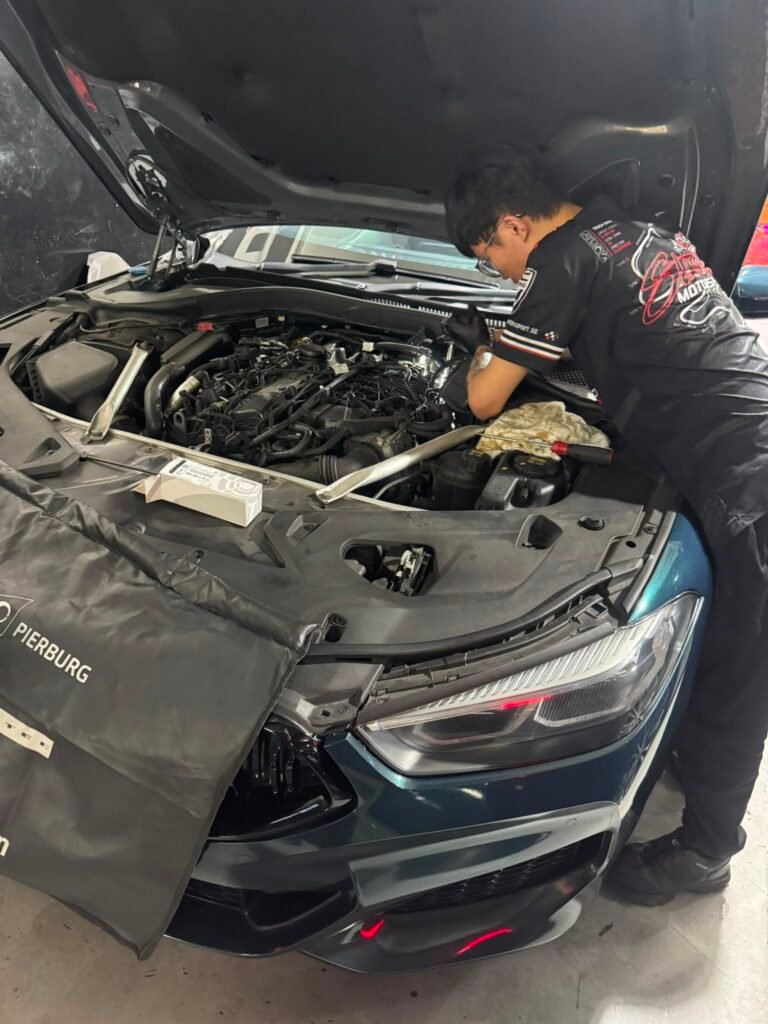
When the car leaves us, you know which part failed and why, not just that “something was changed”. That’s the difference between a dealer-grade diagnosis and a parts gamble.
BMW spark plugs: how often, really
BMW’s schedule typically calls for plugs somewhere between 60,000 and 100,000 km depending on the engine. For the way cars are driven here, we usually recommend looking at them closer to 40,000 to 60,000 km, and sooner if you’re already chasing a misfire. Plugs are cheap relative to the damage a prolonged misfire does, so there’s little sense stretching them.
We fit the correct OEM-specification plugs for your engine, gapped to BMW’s figure. Wrong-spec or wrongly gapped plugs are a surprisingly common cause of a misfire that “came back” after a cheap service elsewhere.
BMW ignition coils: replace one or the whole set?
If one coil has failed and the others are recent and healthy, replacing the single coil is fine. But when the original coils are all the same age and one has died of heat fatigue, the others are usually not far behind. On an older car with the factory coils still fitted, doing the full set alongside the plugs saves you coming back twice and chasing the misfire around the engine for the next three months.
We’ll tell you honestly which situation yours is in once we’ve read the car.
BMW misfire repair cost in Singapore: a guide, not a quote
Every car is different, so treat these as typical ranges for parts and labour at an independent workshop. We’ll always confirm the exact figure after we’ve looked at your car and before any work starts.
| Job | Typical range (SGD) |
|---|---|
| ISTA diagnostic scan | $80 – $150 (often credited if work proceeds) |
| Spark plugs, 4-cylinder (B48) | $180 – $320 |
| Spark plugs, 6-cylinder (B58) | $280 – $450 |
| Ignition coil, per coil | $90 – $160 |
| Plugs + full coil set, 4-cylinder | $500 – $850 |
| Plugs + full coil set, 6-cylinder | $750 – $1,200 |
Dealer pricing for the same work routinely lands well above the top of these ranges. Same diagnostic system, same OEM parts, independent-workshop labour. That’s the trade.
What happens if you keep driving with a misfire
A misfire isn’t something that quietly waits for you. Every misfire pushes unburnt fuel into the exhaust, and that fuel ignites in the catalytic converter. Enough of it and you don’t have a $150 coil problem any more, you have a four-figure catalytic converter problem, and on some cars a melted cat can send debris back into the engine.
The car will usually protect itself by dropping into reduced power (“limp mode”) first. If yours has done that, or the light is flashing, stop driving it and call us before it turns into the expensive version.
BMW misfire FAQs
Can I drive my BMW with a misfire?
Briefly and gently, if the light is steady. If it’s flashing, no. A flashing light means active damage to your catalytic converter, so pull over safely and get the car to us rather than risking a much larger bill.
How do I know if it’s the coil or the spark plug?
From the driver’s seat you usually can’t. Both cause the same symptoms. We read the misfire data on ISTA and swap-test the coil to confirm which part is at fault before replacing anything.
What does a P0300 or P0302 code mean on a BMW?
P0300 means the engine has detected misfires on more than one cylinder, or randomly. P0301 to P0306 point to a specific cylinder, so P0302 is cylinder 2. On BMW inline engines cylinder 1 is at the front, nearest the radiator. The code tells you where the misfire is, not why, so the coil, plug and injector on that cylinder still need checking before anything is replaced.
Should I replace all the ignition coils at once?
Not always. If one coil failed and the rest are newer, we replace the one. If the whole set is original and the same age, doing them together usually works out cheaper than repeated visits.
How much does it cost to fix a BMW misfire in Singapore?
For most cars it lands between roughly $300 and $850 for plugs and coils, depending on engine and how many parts are needed. We confirm the figure after diagnosis and before starting.
My misfire only appears when the engine is hot. Why?
That’s the classic sign of a failing ignition coil. The insulation breaks down once it heats up, so the car runs fine cold and starts stumbling after it’s warmed through.
Will a BMW misfire go away on its own?
Sometimes the light goes out and the shake seems to stop, especially once a failing coil cools down. The fault is still stored in the engine’s memory, and coils and plugs don’t repair themselves, so expect it to come back, usually at a worse moment.
Dealing with a shaking BMW? Let’s find the cylinder.
If your BMW is juddering at idle, stuttering on acceleration, or showing an engine light, don’t let it keep dumping fuel into the exhaust. We’ll read the car on ISTA, tell you exactly which cylinder and which part is at fault, and quote you before we touch anything.
WhatsApp us at +65 9339 2769 or drop by the workshop at Carros Centre, Woodlands.
Dealer knowledge. Independent price.