You catch it before you see it. A faint burning smell drifting through the vents after a longer drive, worse when you’re stuck in traffic. Then a few dark spots on the driveway where the front of the car sits. Pop the bonnet and the top of the engine looks oily, or there’s a grimy film running down one side. A BMW oil leak in Singapore is almost always a gasket letting go, and nine times out of ten it’s one of two: the valve cover gasket or the oil filter housing gasket.
Both are among the most common repairs we do on BMWs at the workshop. Neither will strand you the way an overheat will, but an oil leak that’s ignored gets messier and more expensive the longer it runs, and in the worst case oil dripping onto a hot exhaust is a fire risk. Here’s how to tell which gasket is leaking, why they fail so reliably in Singapore, and what it costs to fix properly.
Which BMWs Get Oil Leaks
This isn’t a one-model problem. The valve cover gasket and oil filter housing gasket are wear items across most of BMW’s four and six-cylinder range, so if you own any of these, it’s a matter of when rather than if:
- N20 / N26 (2.0-litre turbo four): 320i, 328i, 520i, X1, X3 from roughly 2011 to 2017
- N52 / N53 (naturally aspirated straight-six): 320i, 325i, 330i, 523i, 525i, 530i, X3, Z4 of the E90/E60 era
- N54 / N55 (twin-turbo and single-turbo straight-six): 335i, 535i, 135i, X5/X6, and the earlier M cars
- B48 / B46 (current 2.0-litre turbo four): the newer 320i, 330i, 520i, X1, X3
- B58 (current 3.0-litre turbo six): 340i, 540i, M340i, Toyota Supra
The N20, N52, and N54/N55 are the ones we see most often for oil leaks, simply because there are a lot of them on the road here and they’ve now aged into the window where the gaskets give up. Newer B-series engines get there too, just later.
Why BMW Gaskets Leak in Singapore
The same thing that ages BMW cooling plastics ages the oil gaskets: heat, constantly. A valve cover gasket is rubber, and an oil filter housing gasket is a set of rubber seals. Rubber stays soft and sealed when it’s cycled gently. Run it through years of Singapore heat, stop-start traffic, and long idles baking in a car park, and it hardens, shrinks, and loses its squeeze. Once it goes stiff, it can’t fill the gap between the metal surfaces any more, and oil starts to weep out under pressure.
On top of that, BMW valve covers on several of these engines are moulded plastic rather than metal. The plastic can warp slightly with heat over time, which stops the cover sitting flat and makes even a fresh gasket leak sooner than it should. This is why we always check the cover itself, not just the gasket, on the older sixes.
So a BMW oil leak in Singapore usually isn’t a sign anything was done wrong. It’s an age-and-climate failure, and it’s predictable enough that it’s worth understanding before it happens to you.
The Valve Cover Gasket Leak
The valve cover sits right on top of the engine and seals in the oil that lubricates the top end. Its gasket runs around the edge of the cover and around each spark plug tunnel.
When it leaks, oil escapes from the top of the engine and runs down wherever gravity takes it, very often onto the exhaust manifold on the side of the block. That hot manifold cooks the oil, which is where the burning smell and the occasional wisp of smoke from the engine bay come from. Look for:
- A burning-oil smell after driving, strongest in traffic or at idle
- Oil residue or a wet, shiny look around the top edge of the engine
- Thin smoke from the engine bay when the car is hot
- Oil pooling in the spark plug tunnels (on some engines this causes misfires)
- Slowly dropping oil level between services
That last point about the spark plug tunnels matters. On engines where oil seeps into the plug wells, it can foul the coils and plugs and cause a rough idle or misfire, so a valve cover leak sometimes shows up first as a running problem rather than a visible one.
The Oil Filter Housing Gasket Leak
The oil filter housing is where your oil filter lives, bolted to the side of the engine. It’s sealed to the block with a large gasket, and on many BMWs the same housing also carries the oil cooler and coolant passages running through it.
When this gasket fails, oil leaks from the side of the engine and runs down the block, often collecting on the subframe or dripping onto the floor from lower down than you’d expect. The tell-tale signs:
- Oil coating the side or lower half of the engine, rather than the top
- Fresh oil drips on the ground toward the middle or side of the car
- Oil level dropping faster than a valve cover leak usually causes
- On housings that carry coolant, oil and coolant mixing, which shows up as a milky, mayonnaise-like residue on the oil cap or in the expansion tank
The coolant angle is the important one. Because some of these housings pass coolant right next to the oil, a failed gasket can let the two mix. If you ever see a creamy sludge under the oil cap, stop driving and get it checked, because oil and coolant crossing over is a fault you don’t want to run the engine on.
How to Tell Which Gasket Is Leaking
Here’s the catch: from the driver’s seat, a valve cover leak and an oil filter housing leak can feel identical. Both give you a burning smell and a low oil level. And on a car that’s been leaking for a while, oil spreads across the whole side of the engine and coats everything, so you genuinely can’t tell by eye where it started.
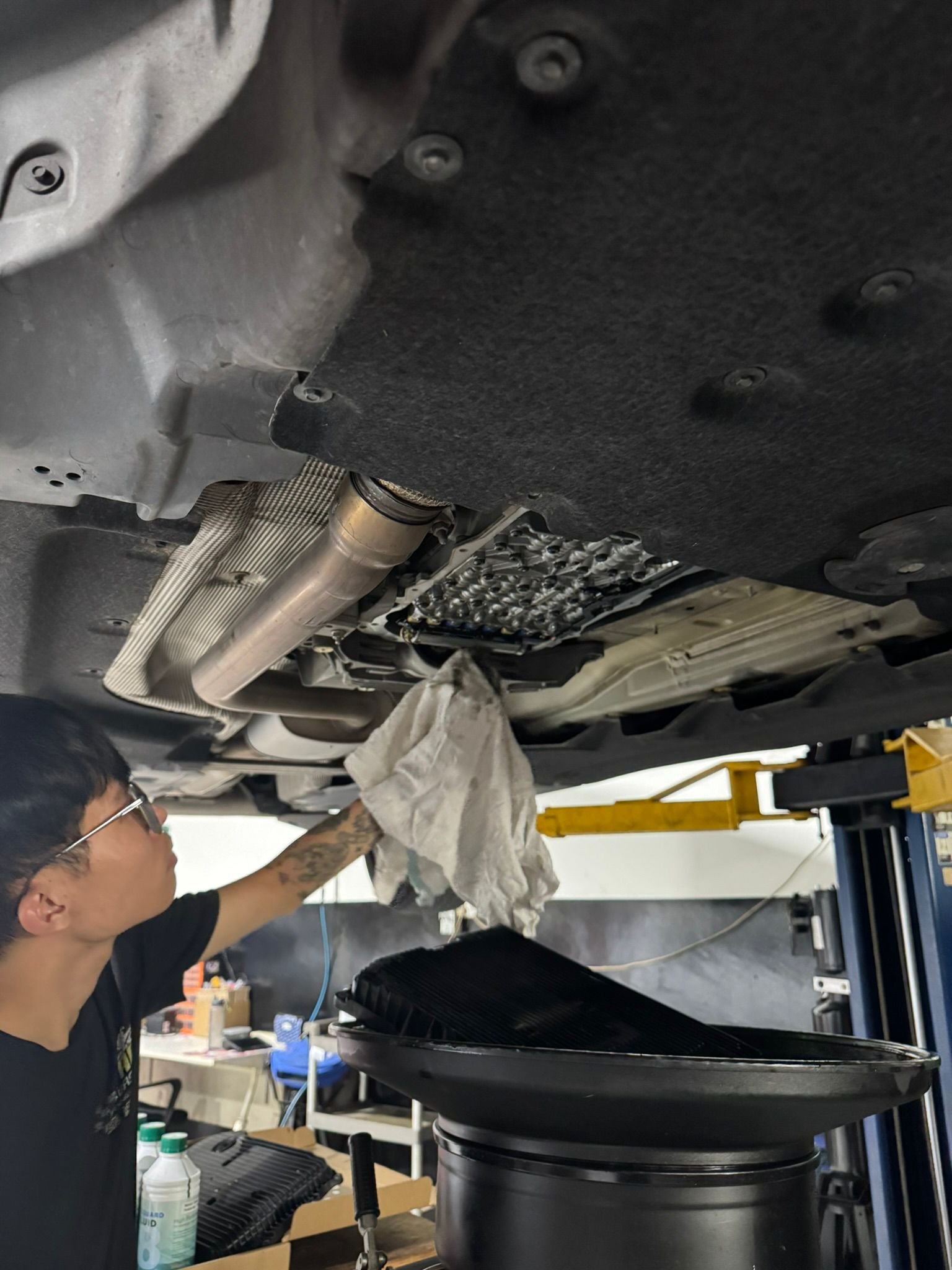
The honest answer is that guessing wastes money. Replace the valve cover gasket when it was actually the housing, and you’ve paid for a job that fixes nothing. The reliable way is to clean the engine down completely, run it, and see where fresh oil appears, sometimes with a UV dye added to the oil so the exact source glows under a UV lamp. That’s how we pin it to the real leak instead of throwing parts at it. It’s also common to find both are leaking on a higher-mileage car, since they’re the same age and living in the same heat.
Can You Keep Driving With a BMW Oil Leak?
For a short while, yes, but don’t let it run. An oil leak isn’t the instant danger an overheat is, so you’re not going to blow the engine tomorrow. The risks build slowly and then bite:
- Low oil. A leak that goes unwatched can drop the level far enough to starve the engine, and running a BMW low on oil causes real wear.
- Fire risk. Oil dripping onto a hot exhaust is the one that turns serious. It’s rare, but it’s why a heavy valve cover leak shouldn’t wait.
- It spreads. Oil softens nearby rubber, creeps into the wiring loom and hoses, and makes the eventual repair bigger and dirtier than if you’d caught it early.
So keep an eye on your oil level, and if you’re smelling burning oil regularly or topping up between services, book it in rather than living with it.
How We Diagnose a BMW Oil Leak
Tracing a BMW oil leak in Singapore is a process, not a guess. We don’t quote a gasket off a phone photo, because the photo almost never shows the real source. In the workshop we degrease the engine, run it up to temperature, and trace exactly where fresh oil is coming from, using UV dye when the leak is slow or hidden. On a BMW we also plug into ISTA, the same diagnostic platform the dealer uses, to check for any related faults and rule out oil getting into the coolant.
That step matters because it separates a simple single-gasket job from a car that’s leaking in two places, and it tells you whether the plastic valve cover itself needs replacing rather than just its gasket. You end up paying for the repair the car actually needs, not a guess. For how we approach BMW diagnostics generally, see our piece on why we use ISTA on every BMW.
BMW Oil Leak Repair Cost in Singapore
Cost comes down to which gasket has failed, which engine you have, and how buried the part is. Some valve covers come off in an hour; others sit under the intake manifold and take real labour to reach. As a rough guide for 2026, using genuine or OEM-equivalent parts:
| Repair | Typical cost (2026) |
|---|---|
| Valve cover gasket replacement | S$350 to S$650 |
| Valve cover replacement (warped plastic cover + gasket) | S$650 to S$1,100 |
| Oil filter housing gasket replacement | S$300 to S$600 |
| Oil filter housing gasket + oil cooler seals | S$500 to S$850 |
| Both gaskets done together | S$650 to S$1,100 |
Prices vary with model and parts choice, so treat these as a guide rather than a quote. The engines with the intake sitting over the valve cover, and the sixes generally, land at the higher end because of the extra labour to get in. For how these repairs sit inside overall running costs, see our breakdown of BMW servicing costs in Singapore.
Why the Two Often Go Together
If your BMW is old enough to leak from one of these gaskets, the other is the same age and heading the same way. That’s why, on a higher-mileage car, we’ll often recommend doing both while the engine is already opened up and half the labour overlaps. Paying the access labour once instead of twice, a few months apart, is the cheaper path.
The other habit worth keeping is checking your oil level yourself between services. A leak caught as a top-up now is a straightforward gasket job; a leak found because a warning light came on has usually run far enough to make more mess. Sticking to sensible service intervals helps too, since fresh oil and a proper inspection each visit is how these get spotted early. Our BMW servicing guide for Singapore covers the intervals worth keeping to.
Frequently Asked Questions
How much does it cost to fix a BMW oil leak in Singapore?
Between roughly S$300 and S$650 for a single valve cover or oil filter housing gasket, and around S$650 to S$1,100 if both are done together or the plastic valve cover itself needs replacing. A proper trace of the leak first tells you exactly which job you’re paying for.
What are the most common oil leaks on a BMW?
The valve cover gasket and the oil filter housing gasket, by a wide margin. Oil pan gaskets and VANOS seals leak too, but far less often than these two.
Is a BMW oil leak dangerous?
Not immediately, but it shouldn’t be ignored. The real risks are running the engine low on oil and, in a heavy leak, oil dripping onto the hot exhaust, which is a fire hazard. Keep an eye on your oil level and get it looked at rather than living with it.
Why does my BMW smell like burning oil but there’s no puddle?
Classic valve cover gasket leak. The oil runs down onto the hot exhaust manifold and burns off before it ever reaches the ground, so you smell it long before you see a drip.
Can I just keep topping up the oil instead of fixing the leak?
You can for a little while, but it gets worse, not better. The leak spreads, the smell gets stronger, and the eventual repair is bigger and dirtier. It’s cheaper to fix the gasket than to keep feeding the leak.
Get Your BMW Oil Leak Sorted Before It Spreads
A valve cover or oil filter housing gasket leak is one of the most common BMW oil leaks in Singapore we fix, and one of the most manageable when it’s caught early. Left alone, it turns a clean gasket job into a greasy, wiring-soaked one, and in the worst case a fire risk.
At TEC AUTO SERVICES in Woodlands, we trace BMW oil leaks properly, degreasing the engine and using UV dye and full ISTA diagnostics to find the real source instead of guessing at parts. As an independent BMW specialist, we keep the dealer-grade tooling and lose the dealer overheads. If your BMW is smelling of burning oil, marking the driveway, or dropping oil between services, book a diagnostic with us or WhatsApp us at +65 9339 2769.