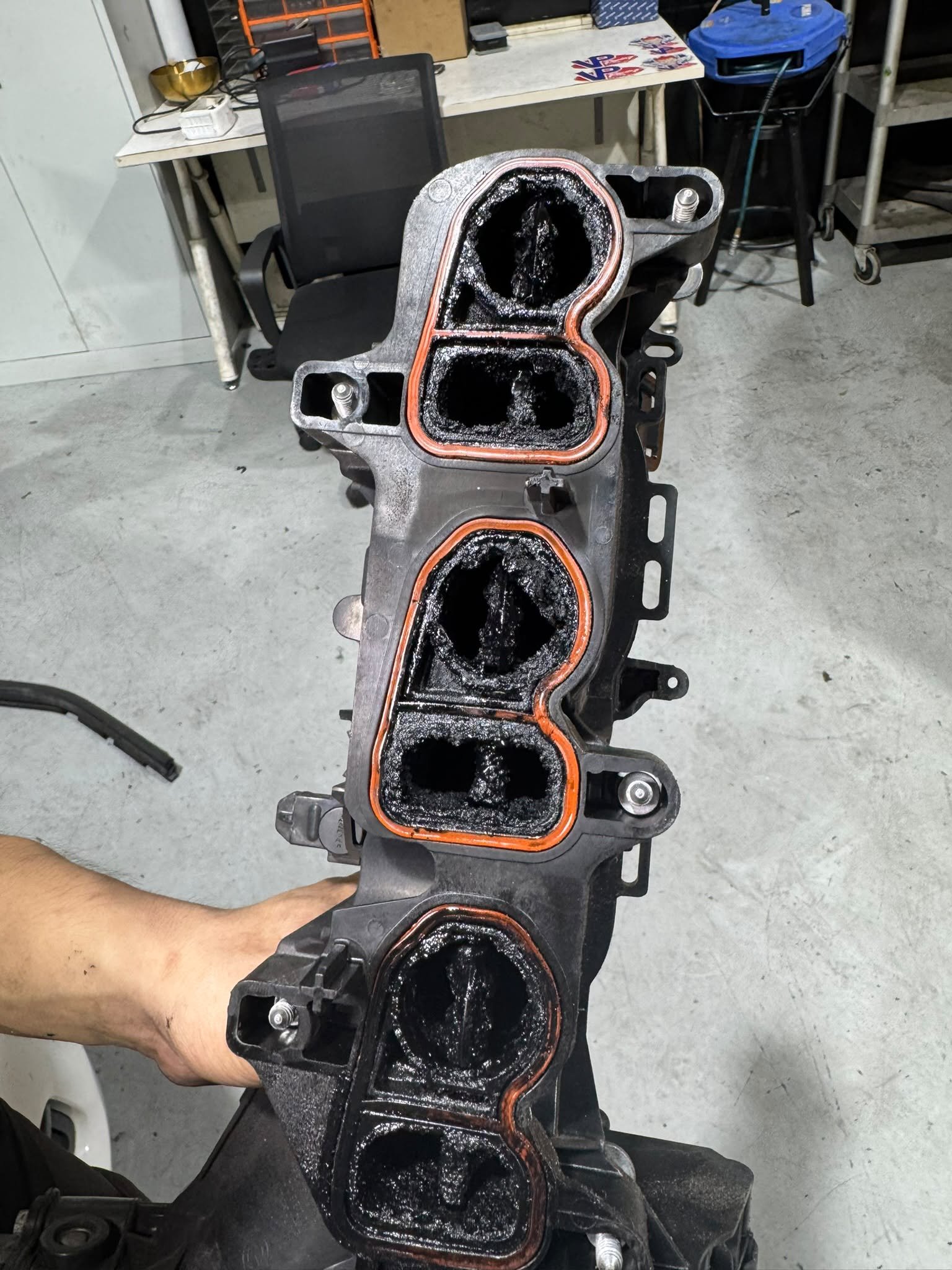
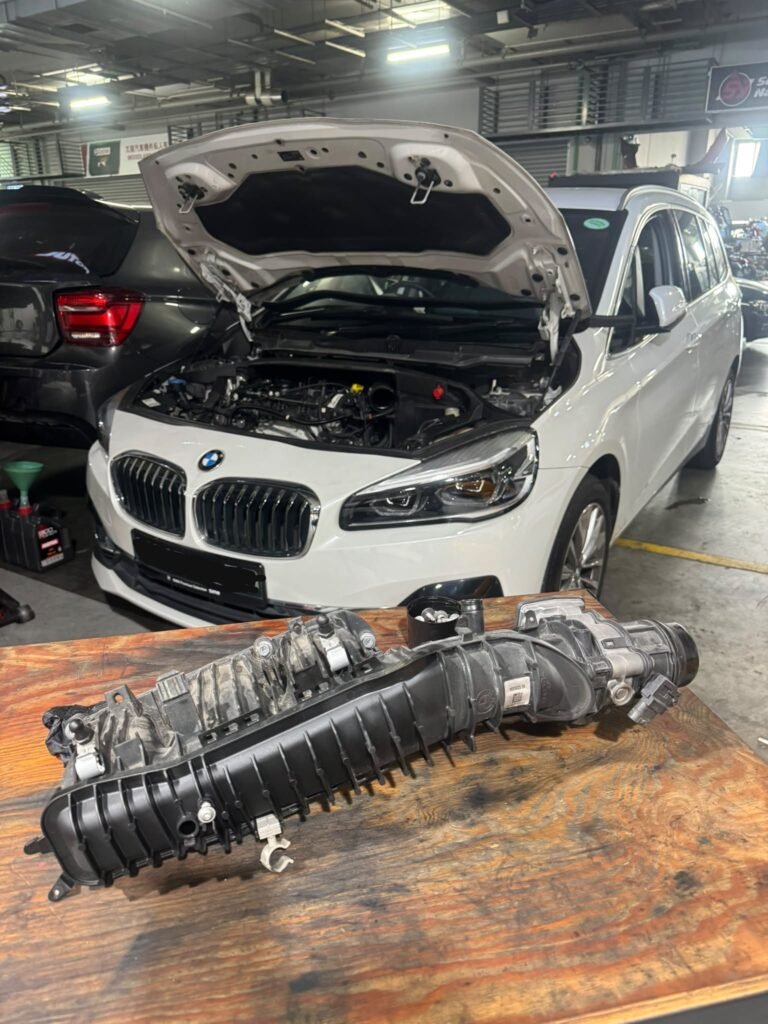
A BMW 335i came into the workshop last month with a complaint the owner had been chasing for a while: a rough, shaky idle, a flat spot when pulling away, and fuel economy that had quietly got worse. He’d already changed the spark plugs and swapped an ignition coil on a guess. None of it helped. We put it on ISTA, saw the misfire counts, pulled the intake manifold, and there it was: the backs of the intake valves caked in hard black carbon, thick enough to choke the airflow.
That’s carbon buildup, and on a direct-injection BMW it isn’t a fault so much as a maintenance item most owners have never heard of. The fix is walnut blasting. Here’s what causes the carbon, which BMWs get it, how walnut blasting cleans it out, and what it costs in Singapore.
Why BMW Intake Valves Carbon Up
To understand the problem you have to know how the fuel gets into the engine. Older BMWs used port injection, which sprays fuel into the intake port, so petrol constantly washes over the back of the intake valve and keeps it clean. Modern BMWs switched to direct injection, which sprays fuel straight into the cylinder for better power and economy. It works, but it has a side effect: the intake valve never gets that fuel wash any more.
Meanwhile, a fine mist of oil vapour is always drifting through the intake from the crankcase breather system, and a little exhaust gas gets recirculated too. On a direct-injection engine there’s nothing to rinse the valve, so that oily residue bakes onto the hot valve and hardens into carbon, layer after layer, over tens of thousands of kilometres. Give it long enough and the deposit gets thick enough to disrupt airflow into the cylinder, and that’s when the running problems start.
None of this means the engine is faulty or that anything was done wrong. It’s simply how direct injection behaves, and it’s why carbon cleaning has become a normal part of looking after a modern BMW.
Which BMWs Get Carbon Buildup
If your BMW runs a direct-injection engine, carbon on the intake valves is a matter of when, not if. The common ones we see in the workshop:
- N54 and N55: the twin-turbo and single-turbo straight-sixes in the 135i, 335i, 535i, X5, X6 and the earlier M cars. These are the classic candidates.
- N20 and N26: the 2.0-litre turbo fours in the 320i, 328i, 520i, X1 and X3 from roughly 2011 to 2017.
- N63: the twin-turbo V8 in the 550i, 650i, X5 and X6.
- S55 and S63: the M-car engines in the M2, M3, M4, M5 and X5 M / X6 M.
Two useful exceptions. The older N52 straight-six is port injected, so its valves stay clean and it doesn’t need this. And BMW’s newer B-series engines, the B48 and B58 in current 320i, 330i, 340i and similar, use both direct and port injection, so the port squirters help keep the valves cleaner and carbon builds far more slowly. It’s the direct-injection-only generation, roughly 2007 to 2016, that carbons up the hardest.
Why It Happens Faster in Singapore
Carbon buildup is driven by how the car is used, and Singapore driving is close to the worst case. Short trips, constant stop-start traffic, and long idles in car parks mean the engine spends a lot of time at low load and never gets a proper run to burn things clean. More idling means more oil vapour drifting past the valves and less airflow to carry it through. The same drive to Woodlands and back every day that’s gentle on the clock is exactly the pattern that lets carbon pack on. Cars that see regular expressway runs tend to carbon up a little slower, but no direct-injection BMW escapes it here.
Symptoms of Carbon Buildup
Carbon comes on gradually, so a lot of owners get used to it without realising. Watch for:
- A rough or shaky idle, especially when cold
- A misfire or stumble, sometimes with the check engine light and a cylinder misfire code
- Hesitation or a flat spot when accelerating, particularly from low revs
- Noticeably worse fuel economy than the car used to return
- A slight loss of power and throttle sharpness
The tell is that these creep in slowly rather than appearing overnight, and they don’t get fixed by new plugs or coils. If you’ve already thrown ignition parts at a rough-running older BMW and it’s no better, carbon on the intake valves is the next thing to check.
What Is Walnut Blasting?
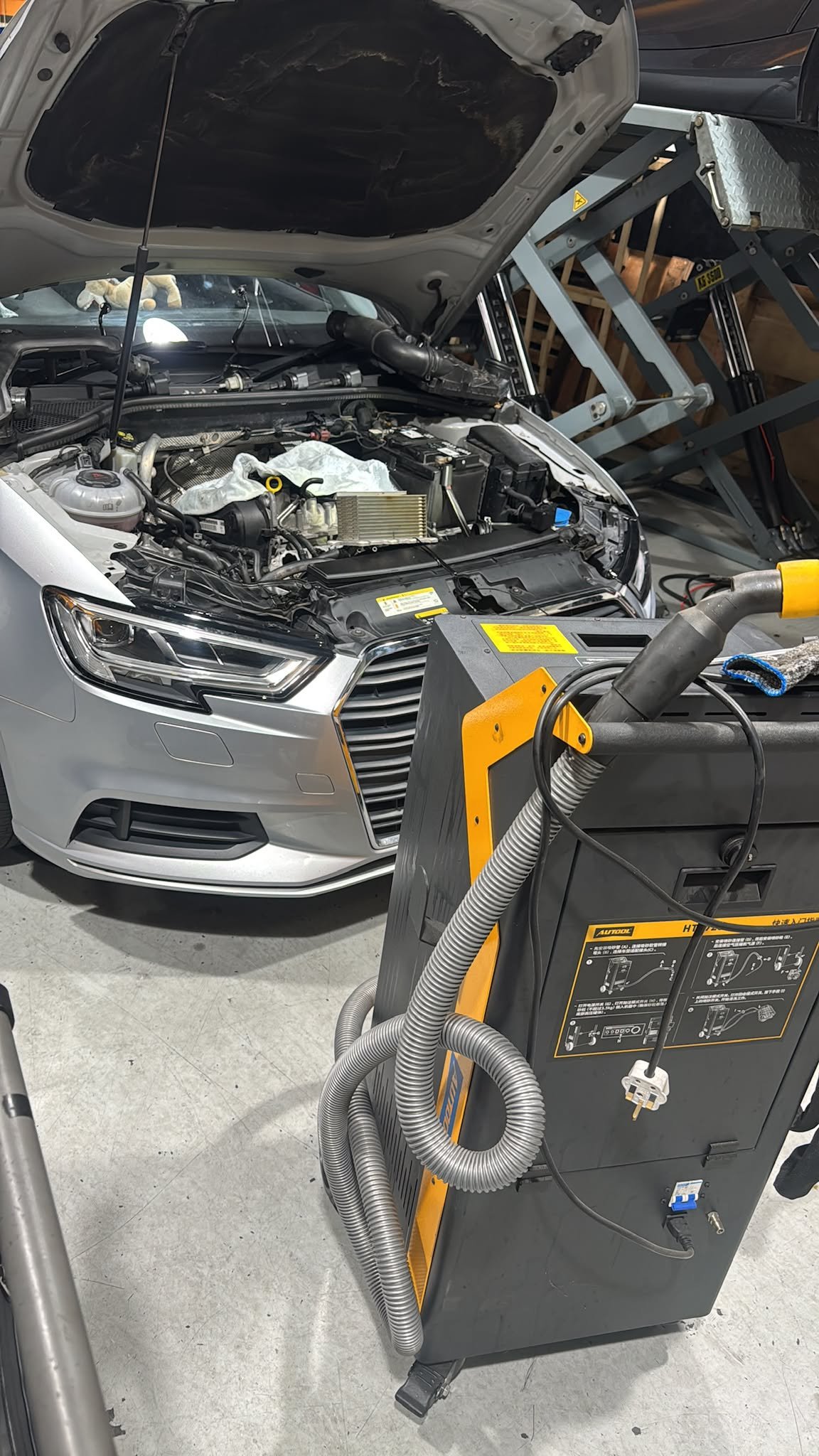
Walnut blasting is exactly what it sounds like. Crushed walnut shell is blasted at the carbon under air pressure to scrub the intake valves clean. Walnut shell is the right choice because it’s hard enough to strip baked-on carbon but soft enough that it won’t damage the valves or the aluminium head, and any stray media simply burns off harmlessly.
The job itself runs like this. We bring the engine up on ISTA first to confirm the misfires and rule out anything else, then remove the intake manifold to expose the backs of the intake valves. Each cylinder is cleaned with the piston at a point that keeps the valve shut, so no media drops into the engine. A special adapter seals around the port, and while we blast the crushed walnut shell in, a shop vacuum pulls it straight back out along with the carbon it lifts. We work through the cylinders one by one, check every valve is back to clean metal, then reassemble with fresh gaskets. On most BMWs it’s a few hours of work.
Why Walnut Blasting Beats a Bottle of Cleaner
You’ll see spray-in “intake cleaners” and fuel additives that claim to sort carbon out. On a direct-injection engine they do very little for the intake valves, because the fuel and its additives never touch the back of the valve. That’s the whole reason the carbon formed in the first place. Additives can help keep the injectors and combustion chamber clean, but they can’t reach the deposit that’s actually causing your rough idle.
Chemical soaks and “seafoam” style treatments are messier and, on heavy deposits, only soften the surface. Walnut blasting physically removes the carbon back to bare metal, which is why it’s the method BMW specialists use and why the results last. It’s mechanical, thorough, and it fixes the problem rather than masking it.
How We Diagnose It
We don’t pull an intake manifold on a hunch. On a BMW we plug into ISTA, the same diagnostic platform the dealer uses, to read live misfire data and confirm the pattern points to airflow and carbon rather than an ignition or fuel fault. Where there’s any doubt, a borescope down the intake port shows the state of the valves before we commit to the job. That way you’re paying to clean valves that are actually dirty, not guessing. Our approach to BMW diagnostics is the same across every job, and you can read more in our piece on why we use ISTA on every BMW.
BMW Walnut Blasting Cost in Singapore
Cost depends mainly on the engine and how much labour it takes to get the intake manifold off. A four-cylinder is quicker to access than a V8 buried under half the engine bay. As a rough guide for 2026:
| Engine | Typical walnut blasting cost (2026) |
|---|---|
| 4-cylinder (N20, N26) | S$400 to S$650 |
| 6-cylinder (N54, N55) | S$550 to S$850 |
| V8 (N63) and M engines (S55, S63) | S$800 to S$1,400 |
Prices vary with model and how heavy the deposits are, so treat these as a guide rather than a quote. It’s often worth doing a fresh set of spark plugs at the same time, since the intake is already off and the labour overlaps. For how carbon cleaning fits into the bigger picture of running a BMW here, see our breakdown of BMW servicing costs in Singapore.
How Often Should You Do It?
There’s no warning light for carbon, so most owners go by mileage and symptoms. On a direct-injection BMW, somewhere around 80,000 to 100,000 km is a sensible point to inspect the valves, sooner if the car is doing mostly short city trips and you’re noticing a rougher idle. Some owners clean earlier as preventive maintenance; others wait until symptoms show. Either is fine, as long as you’re not ignoring a misfire for months and letting it get worse.
You can slow the buildup a little with regular expressway runs and by keeping to sensible oil-change intervals with a quality oil, since cleaner oil means less vapour baking onto the valves. An oil catch can also reduces how much oil mist reaches the intake. None of these stop carbon entirely on a direct-injection engine, but they buy you time between cleans. Our BMW servicing guide for Singapore covers the service intervals worth keeping to.
Frequently Asked Questions
How much does BMW walnut blasting cost in Singapore?
Roughly S$400 to S$650 for a four-cylinder, S$550 to S$850 for a straight-six, and more for a V8 or M engine because of the extra labour to reach the intake. A quick diagnostic first confirms the valves actually need it.
How do I know if my BMW needs walnut blasting?
The usual signs are a rough cold idle, misfires, hesitation on acceleration and worse fuel economy on a higher-mileage direct-injection BMW, especially when new spark plugs and coils haven’t fixed it. A scan and a borescope look at the valves confirm it.
Does walnut blasting damage the engine?
No. Walnut shell is soft enough not to harm the valves or the aluminium head, and the cleaning is done with the valves shut and a vacuum pulling the media straight back out, so nothing gets into the cylinders. Done properly it’s a safe, well-established procedure.
Can I just use a fuel additive or intake cleaner instead?
Not for the intake valves on a direct-injection BMW. The fuel never touches the back of the valve, so additives can’t reach the carbon that’s causing the problem. Walnut blasting is the only method that physically removes it.
How often does a BMW need carbon cleaning?
As a guide, inspect around 80,000 to 100,000 km, sooner if the car does mostly short city trips or you notice a rough idle. There’s no fixed interval, since it depends heavily on how the car is driven.
Get Your BMW’s Carbon Checked Before It Gets Worse
Carbon buildup on the intake valves is one of the most common reasons a higher-mileage direct-injection BMW starts to idle rough, misfire and drink more fuel, and it’s one of the most satisfying to fix, because a proper walnut blast brings the running back to how the car should feel.
At TEC AUTO SERVICES in Woodlands, we confirm carbon with full ISTA diagnostics and a borescope before we touch anything, then walnut blast the intake valves back to clean metal and reassemble with fresh gaskets. As an independent BMW specialist, we keep the dealer-grade tooling and lose the dealer overheads. If your BMW is idling rough, misfiring or feeling flat and it’s overdue for a carbon check, book a diagnostic with us or WhatsApp us at +65 9339 2769.